Person: Mother Teresa
Mother Teresa: A Life Devoted to the Forgotten
Mother Teresa became one of the most recognizable humanitarian figures of the 20th century. For much of her life, she worked with people who were poor, sick, homeless, and forgotten, especially in the streets of Kolkata. Her simple way of life and dedication to serving others made her an international symbol of compassion.
Early Life
Mother Teresa was born Anjezë Gonxhe Bojaxhiu on August 26, 1910, in Skopje, in what was then the Ottoman Empire. She grew up in a deeply religious family and became interested in missionary work when she was still young. At the age of 18, she left her home and joined the Sisters of Loreto, an Irish religious order. Soon afterward, she traveled to India, arriving in 1929. She spent many years teaching at a girls’ school in Kolkata, where she eventually became a principal. Although she enjoyed teaching, the poverty she saw outside the school increasingly affected her.
The Decision That Changed Her Life
In 1946, while traveling by train from Kolkata to Darjeeling, Teresa experienced what she later described as a powerful spiritual calling. She believed she was being asked to leave her teaching work and devote herself to helping the poorest people. After receiving permission to begin her new work, she left the convent school and started working in the streets of Kolkata. She learned basic medical skills, taught children who had little access to education, and cared for people who were sick and dying. Her work began with very little money or support but gradually attracted volunteers and donations.
Founding the Missionaries of Charity
In 1950, Mother Teresa founded the Missionaries of Charity. The organization was created to care for people who had been rejected, abandoned, or left without assistance. The Missionaries of Charity opened homes for the dying, orphanages, shelters, and other facilities for people in need. One of the best-known was Nirmal Hriday, a home in Kolkata for people who were seriously ill and approaching the end of their lives. Mother Teresa believed that people did not simply need food or medical attention. They also needed human connection, kindness, and dignity. What began as a small organization eventually expanded across India and into other parts of the world.
Becoming an International Figure
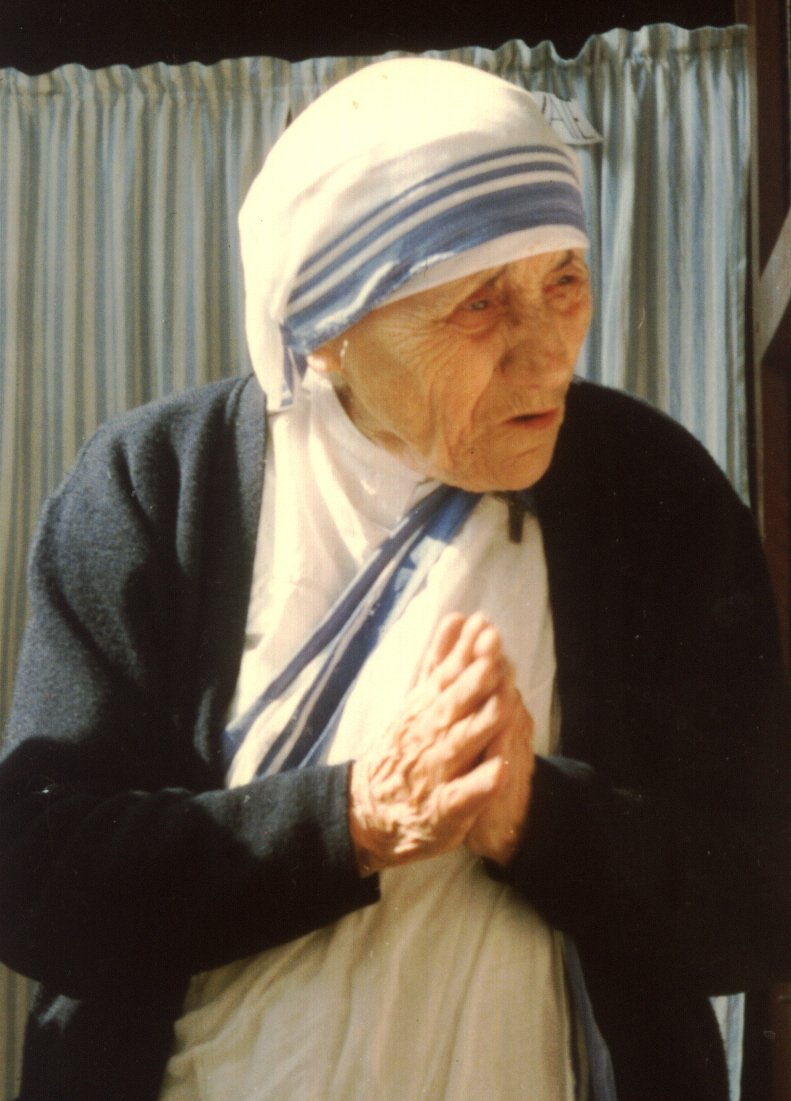
During the 1960s and 1970s, Mother Teresa’s reputation spread far beyond Kolkata. Journalists, volunteers, religious leaders, and public figures visited her institutions and reported on her work. She received many international awards for humanitarian service. In 1979, she was awarded the Nobel Peace Prize. Her acceptance of the prize reflected the philosophy that had guided her work for decades: attention should be given to people who were suffering and often ignored. Her image became familiar around the world. She was often seen wearing the simple white-and-blue sari associated with the Missionaries of Charity.
Criticism and Controversy
Mother Teresa was widely admired, but she was not free from criticism.
Some critics questioned the standard of medical care in certain homes operated by her organization. Others criticized her religious views, particularly her opposition to abortion and contraception. Questions were also raised about the way some donations were handled and about her relationships with controversial political and wealthy figures.
Her supporters argued that her main purpose was to provide shelter, companionship, and dignity to people who otherwise had nowhere to turn. They viewed her work as an expression of religious faith and service rather than as a replacement for modern medical institutions. Because of these disagreements, Mother Teresa’s legacy is often viewed from very different perspectives.
Final Years
Mother Teresa continued working despite increasing health problems. She remained closely involved with the Missionaries of Charity and traveled to different countries to support its growing network. By the 1990s, her health had seriously declined. She died in Kolkata on September 5, 1997, at the age of 87. Her funeral was attended by political leaders, religious figures, volunteers, and ordinary people from many different backgrounds.
A Lasting Legacy
In 2016, Mother Teresa was declared a saint by the Catholic Church and became known as Saint Teresa of Calcutta. The Missionaries of Charity continue its work in many countries, running homes and charitable services for people in need. Mother Teresa’s life remains one of the most discussed humanitarian stories of the modern era. To millions of admirers, she represented selfless service and compassion. To her critics, her methods and beliefs raised important questions about charity, religion, and humanitarian care. Whatever view one takes, her influence on the public understanding of poverty and charitable service is difficult to ignore. Mother Teresa’s story continues to remind people of a simple principle that shaped her life’s work: those who are suffering should not be forgotten.