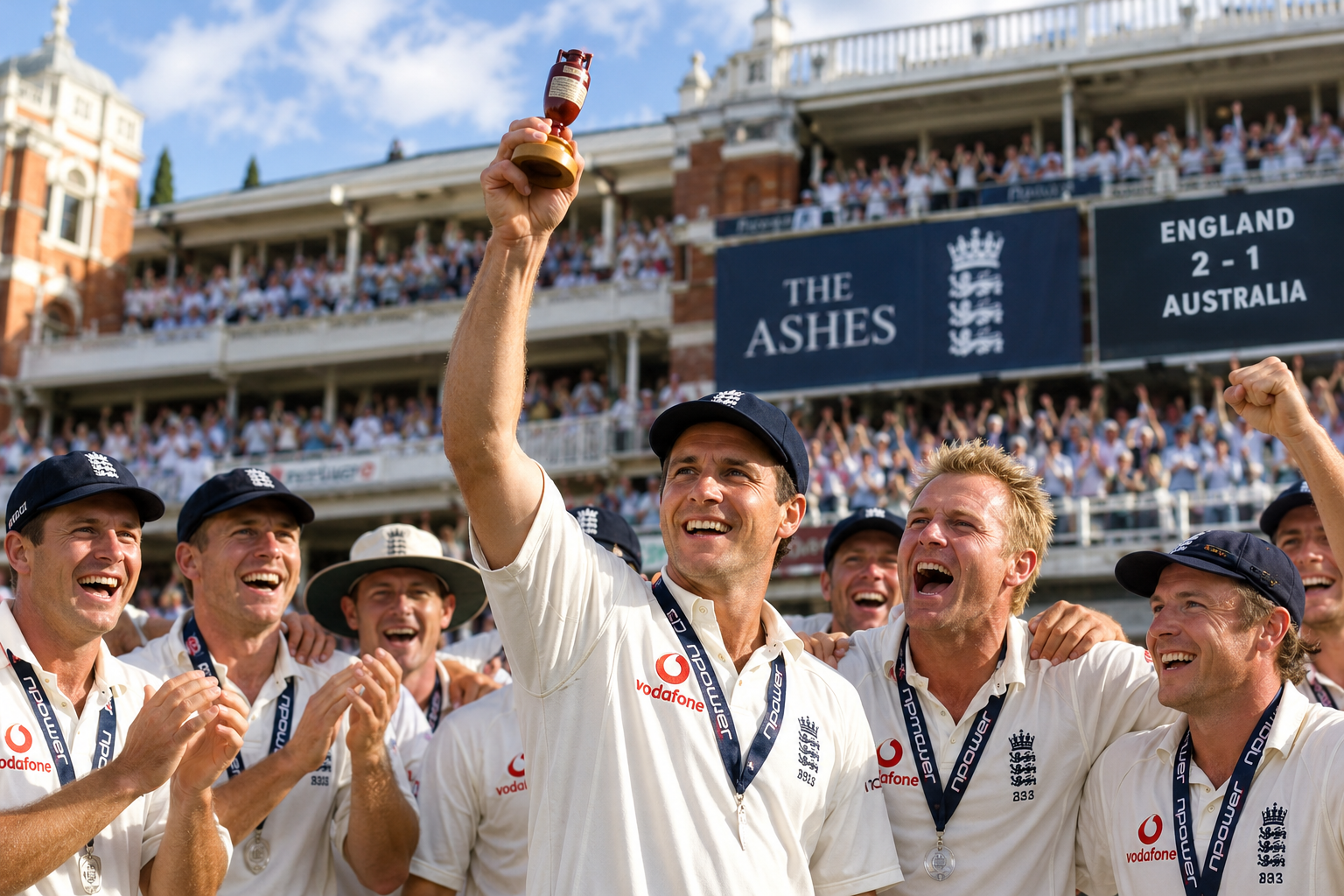
England Regains Cricket’s Greatest Prize
Few rivalries in sport carry the history, emotion, and tradition of the Ashes. Contested between England and Australia, this celebrated cricket series has produced unforgettable performances, dramatic finishes, and moments that have shaped the history of international cricket.
After years of Australian dominance, England finally reclaimed The Ashes in 2005. The victory was more than a sporting achievement. It marked the revival of English Test cricket and became one of the most memorable chapters in the history of the game.
The Origins of the Ashes
The story of The Ashes began in 1882, when Australia defeated England at The Oval in London. The result shocked English cricket supporters, who had expected their team to win at home.
Following the defeat, a satirical obituary appeared in the British newspaper *The Sporting Times*. It announced that English cricket had died and that its ashes would be taken to Australia.
The phrase captured the public imagination. When England toured Australia during the winter of 1882–83, captain Ivo Bligh promised to recover the symbolic ashes.
During that tour, a small terracotta urn became associated with the rivalry. It remains one of cricket’s most recognizable symbols, representing the enduring competition between the two nations.
Australia’s Dominance Before 2005
By the early 2000s, Australia had established itself as one of the strongest teams in international cricket. Under Captain Steve Waugh, the Australian side combined exceptional batting, disciplined bowling, and remarkable mental toughness.
Players such as Ricky Ponting, Adam Gilchrist, Glenn McGrath, and Shane Warne helped Australia dominate world cricket.
England, meanwhile, struggled to match Australia’s consistency. Australia retained the Ashes in 2001 and 2002–03, and its victories reinforced the perception that England faced an enormous challenge.
However, England gradually developed a more competitive side. Under captain Michael Vaughan, the team began combining talented young players with experienced international performers.
The stage was set for a historic contest in 2005.
The 2005 Ashes Series Begins
The 2005 Ashes series began in July, with England determined to end Australia’s long period of control.
Australia entered the series as the defending champion and a formidable opponent. England had home advantage, enthusiastic supporters and growing confidence in its own abilities.
The opening Test at Lord’s ended in a convincing Australian victory, putting England under immediate pressure.
Yet the second Test at Edgbaston changed the direction of the series.
Edgbaston: A Test Match for the Ages
The second Test at Edgbaston, played from 4 to 7 August 2005, became one of the greatest matches in cricket history.
England scored 407 in its first innings, with Andrew Flintoff producing an important contribution. Australia responded with 308, giving England a valuable lead.
In the second innings, England made 182, setting Australia a target of 282 runs to win.
Australia came agonizingly close. The match was decided by just two runs, with England securing a dramatic victory after relentless pressure on the Australian batting order.
Flintoff’s all-round performance and England’s determination became defining images of the series. The result leveled the contest and gave English supporters renewed belief that the Ashes could be recovered.
England Takes the Lead at Trent Bridge
The third Test at Old Trafford ended in a draw, keeping the series finely balanced.
England then won the fourth Test at Trent Bridge in Nottingham. The victory gave the home side a 2–1 lead, putting Australia in danger of losing the series.
England’s bowlers maintained pressure, while the batting line-up delivered important contributions at crucial moments.
For the first time in years, Australia faced the possibility of surrendering the Ashes to England.
The fifth Test at The Oval would decide the outcome.
The Oval: England Regains The Ashes
The fifth Test began at The Oval in London on 8 September 2005.
England entered the match knowing that a victory or draw would secure the series. Australia, meanwhile, needed to win to retain the trophy.
The contest was closely fought. England built a first-innings lead, but Australia continued to resist, ensuring that the result remained uncertain.
Rain interruptions and difficult playing conditions added to the tension. Eventually, the match ended in a draw on 12 September.
That result was enough for England.
The final series score stood at **England 2, Australia 1**, with two matches drawn. England had regained The Ashes for the first time since 1986–87.
Captain Michael Vaughan lifted the symbolic prize after a series that captured the attention of cricket fans around the world.
The Heroes of England’s Triumph
Several players played crucial roles in England’s historic achievement.
**Michael Vaughan:** As captain, Vaughan guided England through a demanding series. His leadership helped build a team capable of challenging Australia’s dominance.
**Andrew Flintoff:** Flintoff became one of the defining figures of the series. His powerful batting, fast bowling and energetic fielding made him central to England’s success. His sporting gesture of consoling Australian batter Brett Lee after the Edgbaston Test became an enduring image of respect between competitors.
**Kevin Pietersen:** Playing in his first Ashes series, Pietersen scored 158 in the final Test at The Oval. His innings helped England establish the position it needed to secure the series.
**Steve Harmison:** The fast bowler contributed important breakthroughs and helped England maintain pressure on Australia’s experienced batting line-up.
**Matthew Hoggard:** Hoggard delivered valuable bowling performances throughout the contest, demonstrating the importance of discipline and persistence in Test cricket.
Together, these players helped turn England’s ambition into a historic achievement.
Why the 2005 Ashes Mattered
The 2005 Ashes series became a landmark in modern cricket for several reasons.
First, it ended Australia’s long hold on The Ashes and restored England’s standing in Test cricket.
Second, the series introduced many casual sports fans to the drama of five-day cricket. The extraordinary Edgbaston finish demonstrated how a Test match could remain uncertain until its final moments.
Third, the contest renewed public interest in English cricket. Packed grounds, extensive media coverage, and enthusiastic supporters helped make the series a major sporting event.
The rivalry also demonstrated that elite sport is about more than individual talent. Preparation, teamwork, resilience, and the ability to perform under pressure were essential to England’s success.
The Legacy of the Ashes
The Ashes remains one of the most important rivalries in international sport. Every series adds another chapter to a story that began in the nineteenth century.
England’s 2005 victory did not end Australia’s competitiveness, nor did it settle the rivalry permanently. Instead, it renewed the contest and gave England supporters a moment to remember for generations.
The series also helped establish the 2005 Ashes as a benchmark against which later Test matches would be judged.
From the symbolic urn to the roar of the crowd at Edgbaston, the history of the Ashes demonstrates how sport can connect generations through shared memories, national pride, and extraordinary performances.
England’s recovery of The Ashes in 2005 was one of cricket’s defining sporting achievements. After years of Australian dominance, Michael Vaughan’s team demonstrated courage, skill, and determination to win a closely contested series.
The two-run victory at Edgbaston, Kevin Pietersen’s century at The Oval, and the final drawn Test combined to create a story that remains central to cricket history.
More than a trophy, the Ashes represents tradition, rivalry, and sporting excellence. England’s 2005 triumph proved that even the most dominant teams can be challenged—and that the greatest sporting moments often emerge from the fiercest competition.
Historical Sources
– ESPNcricinfo — Ashes series history and scorecards.
– BBC Sport — Coverage and retrospective reporting on the 2005 Ashes.
– The Marylebone Cricket Club (MCC) — Historical information about cricket and the Ashes urn.
– Wisden Cricketers’ Almanack — Contemporary records and analysis of the 2005 series.