His Leonardo da Vinci: The Genius Who Changed Art, Science, and History?
Leonardo da Vinci was more than a painter. He was an artist, inventor, scientist, engineer, architect, and one of the most curious minds in human history. Centuries after his death, his paintings continue to attract millions of visitors, while his notebooks reveal ideas that were far ahead of his time.
Born in Italy during the Renaissance, Leonardo spent his life studying the world around him. He observed nature, examined the human body, designed machines, studied flying, and created some of the most celebrated works of art ever produced.
His name is remembered around the world, especially for the Mona Lisa and The Last Supper. But his greatest achievement may have been the way he connected art, science, and imagination.
The Early Life of Leonardo da Vinci
Leonardo da Vinci was born on April 15, 1452, in the small town of Vinci, near Florence, in present-day Italy.
He was the son of Ser Piero, a notary, and Caterina, a woman from a modest background. His parents were not married, and Leonardo grew up mainly in his father’s family.
As a child, Leonardo showed a strong interest in nature. He enjoyed observing plants, animals, water, and the movement of birds. Rather than simply accepting what people told him, he wanted to understand how things worked.
Leonardo received a relatively informal education compared with many other young people of his social position. He studied reading, writing, mathematics, and practical subjects, but his greatest education came from observation and experience.
His curiosity would eventually take him far beyond the small town where he was born.
Leonardo’s Artistic Training in Florence
During his teenage years, Leonardo moved to Florence, one of the most important centers of art and culture in Renaissance Europe.
He became an apprentice in the workshop of Andrea del Verrocchio, a respected painter, sculptor, and goldsmith.
There, Leonardo learned drawing, painting, sculpture, metalworking, and other artistic techniques. He also studied perspective, human anatomy, and the use of light and shadow.
Florence offered opportunities to meet artists, thinkers, engineers, and wealthy patrons who supported creative work.
Leonardo developed his artistic abilities rapidly. By the late 1470s, he was beginning to establish himself as an independent artist.
His early experiences in Verrocchio’s workshop helped shape the extraordinary artist he would become.
The Mona Lisa: The Painting That Became a Legend
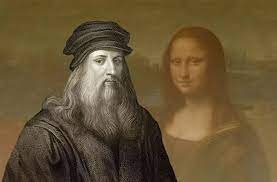
One of Leonardo da Vinci’s most famous paintings is the Mona Lisa.
He is believed to have started the painting around 1503, and he continued working on it over several years.
The portrait shows a woman seated against a distant landscape. Her mysterious expression, gentle smile, and carefully painted eyes have fascinated viewers for generations.
Leonardo used a painting technique known as sfumato, which creates soft transitions between colors and tones. This gave the portrait a remarkably natural appearance.
The identity of the woman is generally believed to be Lisa Gherardini, the wife of Florentine merchant Francesco del Giocondo.
Today, the Mona Lisa is displayed at the Louvre Museum in Paris, France. It is among the most famous paintings in the world.
Its popularity has made Leonardo’s name familiar even to people who know very little about Renaissance art.
The Last Supper: A Masterpiece of Religious Art
Another extraordinary work by Leonardo is The Last Supper, created in the late 1490s.
The painting is located in the refectory of the Convent of Santa Maria delle Grazie in Milan, Italy.
It represents the moment when Jesus tells his disciples that one of them will betray him.
Leonardo carefully arranged the figures to show their different emotional reactions. Some appear shocked, others confused, while a few seem deeply troubled.
The composition draws the viewer’s attention towards Jesus, who occupies the center of the scene.
Unlike traditional fresco painting, Leonardo experimented with a different technique using tempera and oil on a dry wall. Unfortunately, this method caused the painting to deteriorate relatively quickly.
Despite centuries of damage and restoration, The Last Supper remains one of the greatest achievements of Renaissance art.
Leonardo da Vinci: The Inventor Ahead of His Time
Leonardo’s imagination extended far beyond painting.
He designed machines and devices that demonstrated his interest in engineering, transportation, and military technology.
His notebooks contain drawings of:
-
Flying machines inspired by the movement of birds.
-
Aerial screw designs, often compared with early helicopter concepts.
-
Armoured vehicles.
-
Bridges and mechanical systems.
-
Water pumps and engineering equipment.
-
Devices for lifting and moving heavy objects.
Many of these inventions were never constructed during his lifetime. Some were experimental designs, while others would have required technology that was not available in the 15th and 16th centuries.
His flying machine studies are particularly fascinating. Leonardo believed that understanding the movement of birds could help humans achieve flight.
Although his designs did not produce a successful flying machine, they demonstrated an extraordinary interest in aviation centuries before powered aircraft became a reality.
Leonardo’s Interest in Science and Human Anatomy
Leonardo believed that understanding the human body was essential for creating realistic art.
He studied anatomy through observation and dissections, producing detailed drawings of muscles, bones, organs, and the human skeleton.
His anatomical notebooks contain remarkable illustrations of the heart, brain, reproductive system, and other parts of the body.
One of his most recognized drawings is the Vitruvian Man, created around 1490.
The drawing shows a male figure positioned inside a circle and a square. It explores the relationship between human body proportions and geometric principles described by the ancient Roman architect Vitruvius.
Leonardo’s scientific approach was based on observation, experimentation, and careful recording.
Although he was not a modern scientist, his notebooks demonstrate how closely he connected artistic study with scientific investigation.
The Renaissance: The World That Shaped Leonardo
Leonardo lived during the Italian Renaissance, a period of remarkable cultural and intellectual development.
The Renaissance encouraged renewed interest in classical Greek and Roman knowledge, humanism, literature, architecture, mathematics, and scientific observation.
Cities such as Florence, Milan, Venice, and Rome became important centers of artistic activity.
Wealthy families, religious institutions, and political leaders supported artists and thinkers.
Leonardo worked for several powerful patrons, including Ludovico Sforza, the Duke of Milan, and later received support from other influential figures.
His career reflected the Renaissance ideal of a person who could explore many different fields rather than limiting themselves to a single profession.
Leonardo’s Final Years in France
During the later years of his life, Leonardo continued working on artistic and intellectual projects.
In 1516, he accepted an invitation from King Francis I of France and moved to the Château du Clos Lucé, near the royal residence at Amboise.
He was given a position as a royal artist and engineer.
Although age and declining health limited some of his activities, Leonardo continued drawing, studying, and discussing ideas.
He died on May 2, 1519, at the age of 67, in Amboise, France.
His death marked the end of an extraordinary life, but his influence continued through his surviving paintings, drawings, and notebooks.
Interesting Facts About Leonardo da Vinci
Leonardo’s life was filled with fascinating details that continue to interest historians and researchers.
-
He was left-handed: Many of his surviving notebooks contain writing that runs from right to left.
-
He was fascinated by flight: He spent years studying birds and designing flying machines.
-
He filled notebooks with ideas: His surviving notebooks contain thousands of pages of observations, sketches, and experiments.
-
He was also a musician: Leonardo was known for his musical abilities and reportedly played the lyre.
-
He was never married: There is no reliable historical evidence that he married or had children.
-
He worked in several cities: his career took him from Florence to Milan, Rome, and eventually France.
The Legacy of Leonardo da Vinci
More than 500 years after his death, Leonardo da Vinci remains one of the most influential figures of the Renaissance.
His paintings changed the history of art, while his scientific drawings and engineering ideas demonstrated the power of observation and imagination.
He showed that creativity does not have to exist within the boundaries of one subject. Art, mathematics, science, engineering, and nature can all contribute to a deeper understanding of the world.
His work continues to be studied in museums, universities, art schools, and research institutions.
Leonardo’s life also reminds us that great discoveries often begin with simple questions and a willingness to explore.
Leonardo da Vinci’s story is the story of a man who never stopped learning.
From his childhood in Vinci to his final years in France, he remained fascinated by the world around him. He painted masterpieces, studied the human body, designed extraordinary machines, and filled notebooks with ideas that still inspire people today.
He may have lived during the Renaissance, but his imagination reached far beyond his own century.
Leonardo da Vinci was not simply a great painter. He was one of history’s most remarkable thinkers, whose curiosity helped connect art, science, and human creativity.