Person: Charlie Chaplin
Charlie Chaplin: The Little Tramp Who Changed Cinema
Charlie Chaplin was one of the most recognizable figures in the history of cinema. With a bowler hat, toothbrush moustache, oversized trousers, cane, and unmistakable walk, he created a screen character who could make audiences laugh one moment and move them to tears the next.
But Chaplin was more than the man behind the famous Tramp. He was an actor, filmmaker, writer, director, producer, composer, and performer who helped establish cinema as an art form capable of combining comedy with emotion and social criticism. Born in London in 1889, Chaplin experienced poverty and instability during childhood before becoming a successful stage performer. His move into American cinema in the 1910s transformed him into an international star. By the 1920s, he had become one of the most powerful creative figures in Hollywood, exercising an unusual degree of control over his films.
His career also contained contradictions. The man who played a poor wanderer became enormously wealthy. The filmmaker who perfected silent comedy became involved in political controversies during the turbulent years surrounding the Second World War and the Cold War. His private life attracted intense public attention, while his films continued to gain artistic recognition. Chaplin’s importance, therefore, is not simply that he was funny. He demonstrated how physical comedy could carry sophisticated stories about poverty, dignity, industrialization, loneliness, politics, and human resilience. His influence can still be seen in comedy and filmmaking more than a century after his first screen appearances.
Early Life and Childhood
Charles Spencer Chaplin was born on April 16, 1889, in London, England. His parents were performers. His father, Charles Chaplin Sr., was a singer and actor, while his mother, Hannah Chaplin, performed under the stage name Lily Harley. Chaplin’s childhood was marked by financial insecurity. His father died when Charlie was still young, and his mother’s health deteriorated. Charlie and his older half-brother, Sydney, were eventually forced to rely heavily on their own abilities.
The family experienced periods of severe poverty, and Chaplin spent time in institutions for poor children. His early experiences of hunger, unstable housing, and life among London’s working poor later became important influences on his artistic imagination.
His mother’s connection with the theater also exposed him to performance at an early age. Chaplin and Sydney eventually entered the entertainment world, where performance became not only a career but also a means of survival. Chaplin’s difficult childhood should not be treated as a simple explanation for everything he later created. His artistic development was also shaped by British music-hall traditions, pantomime, stage comedy, performers he encountered, and his own extraordinary instinct for physical performance. Nevertheless, poverty remained an important emotional reference point throughout his career.
Charlie Chaplin’s Early Career
Chaplin’s professional stage career began when he was still a child. He performed with the Eight Lancashire Lads, gaining attention for his dancing and comic ability.
As a teenager and young adult, he continued working in British theater. A major turning point came when he joined Fred Karno’s comedy company, an influential British touring troupe known for physical and pantomime-based comedy. Karno’s company gave Chaplin opportunities to develop characters through movement rather than dialogue. The experience proved especially valuable because silent cinema would later require performers to communicate emotions and ideas visually. Chaplin eventually travelled to the United States with the Karno company. His performances attracted the attention of filmmaker Mack Sennett, who hired him for Keystone Studios. Chaplin’s first known film appearance was in Making a Living, released in 1914. It was only the beginning of an extraordinarily productive period.
During 1914, he appeared in numerous short films and began developing the visual language that would make him famous. His early Keystone work was faster and more chaotic than his later films, but it provided the laboratory in which his screen persona began to take shape.
Move to America and Rise to Fame
Chaplin’s move from British stage performance to American filmmaking happened during a period when cinema was rapidly becoming a mass entertainment industry. At Keystone, he initially worked under the direction of others. But he soon wanted greater creative control over his performances and stories. After leaving Keystone, Chaplin worked for the Essanay Film Manufacturing Company, followed by the Mutual Film Corporation and then First National. His films became increasingly sophisticated.
At Mutual, productions such as The Vagabond, Easy Street, The Immigrant, and The Adventurer demonstrated how Chaplin could combine elaborate physical comedy with character development and emotional storytelling.
He was no longer simply performing gags. He was constructing cinematic situations in which comedy emerged from character, environment, timing, and social relationships. By the late 1910s, Chaplin was one of the biggest stars in the world. In 1919, he joined Mary Pickford, Douglas Fairbanks, and D. W. Griffith in establishing United Artists, a company intended to give major filmmakers greater control over the production and distribution of their work. This was an important development in Hollywood history. Chaplin was not simply an employee of a studio system; he increasingly operated as an independent filmmaker with considerable control over his productions.
The Tramp Character
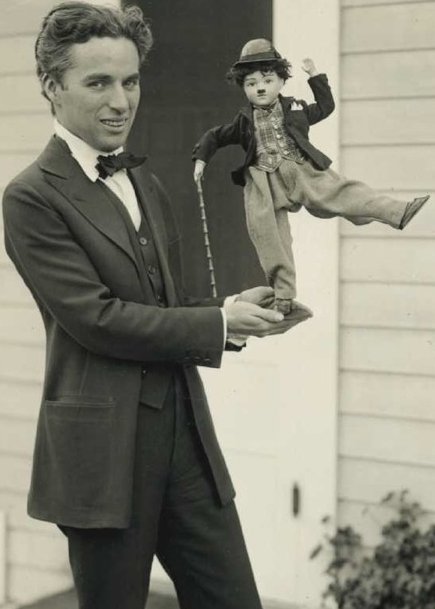
The character who made Charlie Chaplin internationally famous was the Tramp. He first appeared in the 1914 film Kid Auto Races at Venice, although the character’s identity and personality developed gradually across subsequent films. The Tramp was deliberately built from contradictions. He looked poor but behaved with dignity. He was vulnerable but resourceful. He could be selfish or mischievous, yet he frequently displayed compassion toward people even worse off than himself.
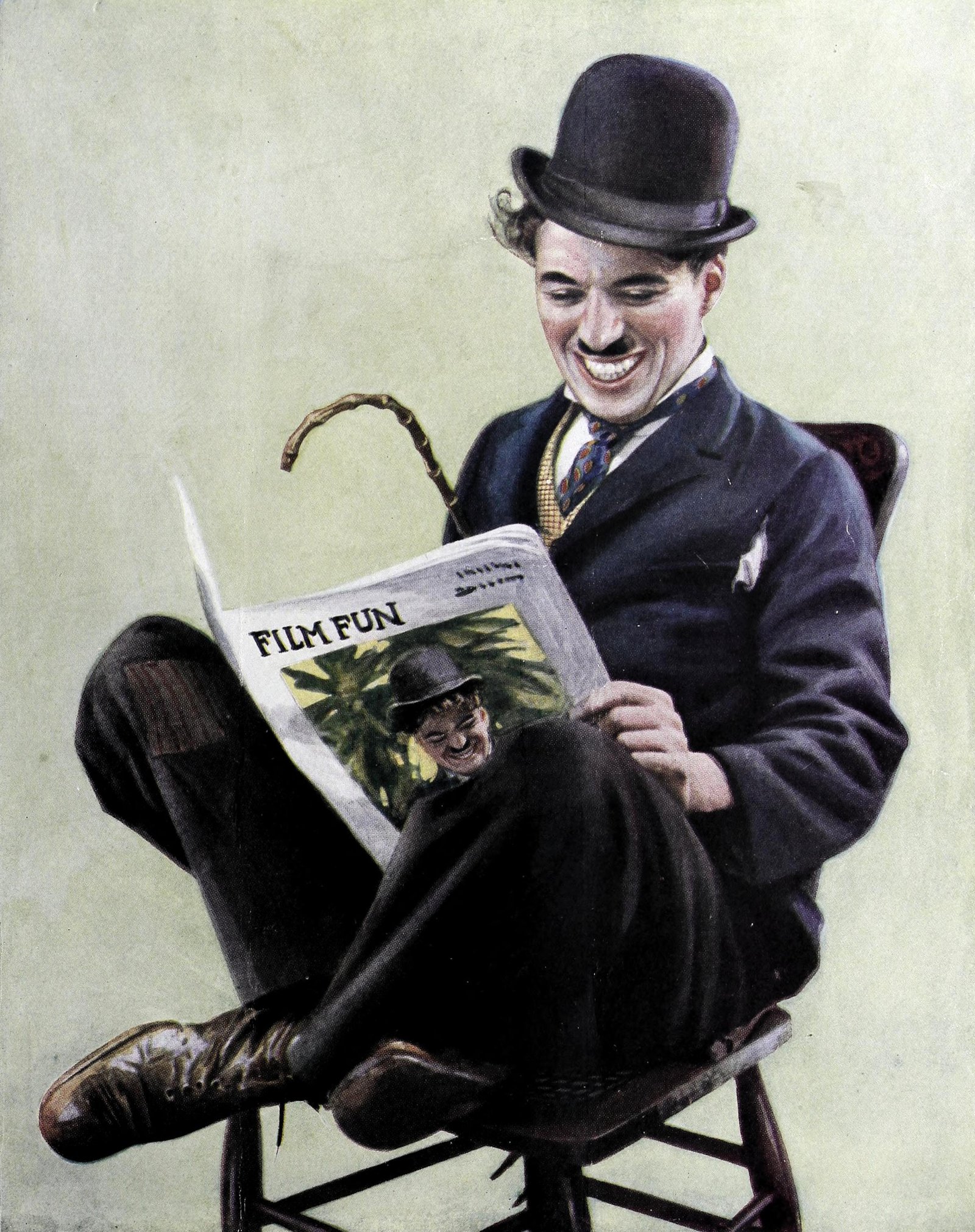
His costume became one of cinema’s most recognizable designs: oversized trousers, a tight coat, large shoes, a small bowler hat, a cane, and a small moustache. Chaplin later explained that he wanted the costume itself to create a contradiction between different elements.
The result was a character who could be recognized instantly, even before he moved or performed. The Tramp also crossed social boundaries. He could enter wealthy environments while remaining visibly poor, allowing Chaplin to create comedy from the collision between social classes. That tension became one of the character’s most enduring qualities. The Tramp was simultaneously an outsider and a survivor. The BFI has noted how closely the character’s emotional world can be connected with Chaplin’s experiences of poverty and hardship, while also emphasizing the broader traditions of music-hall comedy that influenced his development.
Charlie Chaplin’s Greatest Films
The Kid
Released in 1921, The Kid was Chaplin’s first major feature-length comedy. The story follows the Tramp after he discovers an abandoned child, played by Jackie Coogan, and raises him as his own. The film combined slapstick comedy with poverty, family, abandonment, and emotional vulnerability. Its importance lies partly in its balance. Chaplin understood that comedy could become more powerful when audiences genuinely cared about the characters. The relationship between the Tramp and the child provides the emotional foundation for the film, while the comic situations emerge naturally from their difficult circumstances. The Kid was also significant because it drew on material close to Chaplin’s own experiences. The film transformed the suffering associated with poverty into a story that could reach a mass international audience without reducing its characters to stereotypes.
The Gold Rush
Released in 1925, The Gold Rush placed the Tramp in the harsh environment of the Klondike Gold Rush.
The film turned hunger, loneliness, cold, and economic desperation into elaborate visual comedy.
One of its most famous sequences involves the Tramp imagining a meal in circumstances where food is scarce. Another memorable sequence involves his desperate attempts to survive in a remote cabin.
The film demonstrated Chaplin’s ability to build large-scale cinematic comedy around basic human needs.
It also showed his increasing control over filmmaking. He directed and produced the picture, shaping its performances, visual structure, and comic timing.
City Lights
Released in 1931, City Lights arrived after synchronized sound had already transformed Hollywood.
Chaplin nevertheless chose to make the film essentially silent.
The story follows the Tramp’s relationship with a blind flower seller, played by Virginia Cherrill. Believing the Tramp to be wealthy, she misunderstands his social position, while he attempts to help her.
The film combines romantic comedy, physical humor, poverty, generosity, and emotional uncertainty.
Its famous ending demonstrates Chaplin’s unusual ability to move between comedy and pathos without completely separating the two.
At a time when talking pictures were becoming the industry standard, City Lights demonstrated that silent visual storytelling could still produce enormous emotional power.
Modern Times
Released in 1936, Modern Times addressed one of the defining problems of industrial society: the relationship between humans and machines.
The Tramp becomes a factory worker trapped inside a highly mechanized production system.
Chaplin turns the assembly line into a source of physical comedy, but the underlying subject is serious. Workers are treated as components within an industrial process, while economic insecurity and unemployment shape everyday life.
The famous machinery sequences are therefore more than elaborate slapstick. They express anxiety about a modern economy in which efficiency can come at the expense of human dignity.
Although released nine years after the beginning of the sound-film era, Modern Times remained largely silent. It incorporated sound effects, recorded voices, and music, but Chaplin continued to rely heavily on visual performance and intertitles.
The Great Dictator
Released in 1940, The Great Dictator represented one of the most dramatic changes in Chaplin’s career.
It was his first full-length film to make extensive use of spoken dialogue and directly addressed contemporary politics.
Chaplin played two characters: the authoritarian dictator Adenoid Hynkel, a parody of Adolf Hitler, and a Jewish barber whose life becomes entangled with the dictatorship.
The resemblance between Chaplin’s famous moustache and Hitler’s appearance provided the initial comic premise, but the film developed into a much broader attack on fascism, dictatorship, militarism, and antisemitism.The decision was risky. The Second World War was already reshaping international politics, and the Nazi regime represented a very real threat rather than merely a comic target.Chaplin used comedy to ridicule authoritarian power, but the film also became increasingly serious, particularly in its final speech.The film remains historically important not because comedy somehow diminishes the seriousness of fascism, but because it demonstrates how popular entertainment could directly confront political extremism.
Chaplin’s Filmmaking Style and Artistic Genius
Chaplin’s filmmaking was built around movement, timing, character, and visual storytelling.His comedy rarely depended solely on jokes.
A character’s physical position, the movement of an object, the timing of a gesture, or the reaction of another person could become the foundation of an entire sequence.This made Chaplin’s work particularly accessible across language barriers.His films could be understood by audiences who spoke completely different languages because the central emotions were communicated visually.But physical comedy was only one part of his method.
Chaplin carefully balanced laughter with vulnerability. His characters often wanted simple things: food, work, companionship, dignity, love, or security.The obstacles they encountered created the comedy.Music was another major element.Chaplin eventually became deeply involved in composing and arranging music for his films. Music allowed him to control the emotional rhythm of scenes and helped bridge the gap between silent-era filmmaking and later sound cinema.His filmmaking was also unusually personal. He often acted, directed, wrote, produced, and participated in the musical side of his projects.The Academy recognized this unusual range as early as 1929, when Chaplin received a Special Award for his work as actor, writer, director, and producer of The Circus.
Charlie Chaplin and Social Commentary
Chaplin’s comedy frequently focused on people living at the margins of society.
The Tramp was poor, unemployed, socially excluded, and frequently treated as inferior by people with greater wealth or authority.
Yet Chaplin rarely turned his films into straightforward political lectures.
Instead, social criticism emerged through situations.
In The Kid, poverty shapes family relationships.
In The Gold Rush, economic desperation becomes a source of both suffering and comedy.
In Modern Times, industrial production threatens to reduce workers to mechanical parts.
In The Great Dictator, authoritarianism becomes the central political target.
This approach allowed Chaplin to reach audiences who might not have responded to a conventional political argument.
His social commentary was also not always ideologically precise. His films are better understood as expressions of sympathy for ordinary people and skepticism toward systems that treat human beings as disposable than as systematic political theories.
That distinction matters when assessing Chaplin’s historical legacy.
Personal Life and Professional Challenges
Chaplin’s private life was often dramatically different from the image of the lovable Tramp.He married several times, and his relationships became the subject of intense public scrutiny.
His marriages to Mildred Harris, Lita Grey, and later Paulette Goddard attracted significant media attention. His relationship with Oona O’Neill, whom he married in 1943, lasted until his death and produced eight children.
His personal relationships also contributed to controversies surrounding his public reputation.
Chaplin’s fame made privacy difficult, and newspapers frequently reported on his relationships, divorces, and alleged behavior.
One particularly serious episode involved actress Joan Barry, with whom Chaplin had a relationship. A paternity case and related legal proceedings became major public controversies in the 1940s.
These events should be treated separately from Chaplin’s artistic achievements. They are part of the historical record, but they should not be simplified into either a complete condemnation or a defense of his character.
The Library of Congress’s historical newspaper collection illustrates just how extensively Chaplin’s private life was reported during his years of fame.
Controversies and Political Criticism
Chaplin’s later career was increasingly affected by political controversy.
Although he was a British citizen who lived and worked in the United States for decades, Chaplin never became an American citizen.
During the 1930s and 1940s, he became increasingly vocal about social and political issues.
His support for progressive causes, criticism of fascism, opposition to the treatment of political radicals, and public comments about social inequality attracted criticism in an increasingly polarized political environment.
The controversy intensified during the early Cold War.
U.S. authorities investigated Chaplin, and the FBI accumulated a substantial file concerning him. The investigation included allegations of Communist sympathies and concerns about his political associations.
However, it is important to distinguish investigation and accusation from proven Communist membership.
Historical research has found extensive government surveillance and political pressure, but allegations that Chaplin was a formal Communist Party member were never conclusively established. Academic research into the period has emphasized the role of informants, circumstantial evidence, and the broader political climate of the Cold War.
Chaplin’s political reputation was also affected by The Great Dictator. The film’s attack on Hitler and fascism was courageous in historical retrospect, but its political implications were controversial when it was released.
In September 1952, Chaplin travelled from the United States to Britain for the European premiere of Limelight. During the journey, U.S. authorities revoked his permission to re-enter the country.
Chaplin subsequently settled in Switzerland with his family.
It is more accurate to describe this as the end of his long residence in the United States and his effective exile from the country than to suggest that he was simply convicted or formally deported for being a Communist. The historical record is more complicated.
Life After Hollywood
Chaplin continued making films after leaving the United States.
He directed A King in New York in 1957, a satirical film that reflected some of his frustrations with American politics and society.
His final completed feature as director was A Countess from Hong Kong, released in 1967.
Meanwhile, his earlier work gradually experienced renewed critical appreciation.
Chaplin spent his later years in Switzerland, where he continued to write, compose, and oversee aspects of his legacy.
The Chaplin Archive preserves a large collection of his professional and personal documents, including photographs, screenplays, letters, and other materials that allow researchers to examine his career beyond the familiar public image.
One of the most striking developments of his later life was his return to American public recognition.
In 1972, after two decades away from the United States, Chaplin returned to Hollywood to receive an honorary Academy Award.
The Academy recognized the enormous effect his work had on cinema.
The occasion represented a remarkable reversal. The filmmaker who had once become a target of political controversy was now being publicly honored by the American film industry that had helped make him famous.Chaplin died on December 25, 1977, at his home in Corsier-sur-Vevey, Switzerland, aged 88.
Awards and Recognition
Chaplin’s recognition extended far beyond the popularity of his films.
In 1929, the Academy presented him with a Special Award for his work on The Circus, recognizing his versatility as an actor, writer, director, and producer.
In 1972, he received an Academy Honorary Award for his profound influence on motion pictures.
His later honors included:
-
Honorary Academy Award, 1929
-
Honorary Academy Award, 1972
-
Academy Award for Music, awarded for Limelight in 1973
-
BAFTA Fellowship, 1976
-
Knight Commander of the Order of the British Empire (KBE), 1975
BAFTA’s official records identify Chaplin as a 1976 Fellowship recipient, recognizing his exceptional contribution to film.
The Academy’s 1973 records also list Limelight as the winner of the Academy Award for Music (Original Dramatic Score), credited to Charles Chaplin, Raymond Rasch, and Larry Russell.
These honors are significant partly because they arrived after a period when Chaplin’s reputation had suffered substantially in the United States.
Charlie Chaplin’s Legacy
Chaplin’s influence on cinema is difficult to measure because it extends across several generations and several different aspects of filmmaking.
As a performer, he demonstrated how a screen character could become globally recognizable without relying on spoken dialogue.
As a filmmaker, he showed that comedy could contain sophisticated emotional and social themes.
As a producer and creative entrepreneur, he demonstrated the value of artistic control at a time when Hollywood studios increasingly dominated production.
And as a comedian, he established a visual vocabulary that influenced generations of performers.
The Tramp became one of the defining figures of twentieth-century popular culture.
Yet Chaplin’s legacy is not simply the preservation of an old silent-film style.
Modern filmmakers continue to study his ability to control rhythm, movement, reaction, framing, and emotional transitions.
His films also remain useful historical documents. They reveal contemporary anxieties about poverty, industrialization, social class, technological change, war, and political power.The BFI has emphasized Chaplin’s significance as a figure who connected popular entertainment with artistic and social expression. His films could function simultaneously as mass entertainment and serious cinematic work.His influence can also be seen in the continuing survival of visual comedy. Many modern comedians and filmmakers work in a world shaped by techniques that Chaplin and other silent-era performers helped establish: physical storytelling, visual timing, expressive reaction, character-based comedy, and the ability to communicate emotion without extensive dialogue.Chaplin was not flawless, and his personal life and political controversies remain legitimate subjects of historical discussion.But acknowledging those contradictions does not require dismissing his artistic achievements.
His importance comes precisely from the complexity of his career: an impoverished London child became a global celebrity; a silent-film performer became an independent filmmaker; a comedian became a political satirist; and a controversial public figure eventually became one of cinema’s most honored artists.
Charlie Chaplin helped transform comedy from a collection of physical gags into a sophisticated cinematic language.
Through the Tramp, he created a character who could be ridiculous, vulnerable, rebellious, romantic, and deeply human. Through films such as The Kid, The Gold Rush, City Lights, Modern Times, and The Great Dictator, he demonstrated that audiences could laugh while confronting serious questions about poverty, dignity, technology, inequality, and political power.His career was complicated by personal controversies and political conflict, particularly during the later years of his American career. Those issues remain part of his historical record and should neither be ignored nor exaggerated.What remains beyond dispute is the scale of his contribution to cinema.
Chaplin helped prove that the moving image could communicate across language and national boundaries through gesture, rhythm, emotion, and character. More than a century after the Tramp first appeared on screen, Chaplin’s films continue to demonstrate one of cinema’s most enduring possibilities: that a simple gesture can sometimes say more than a thousand words.