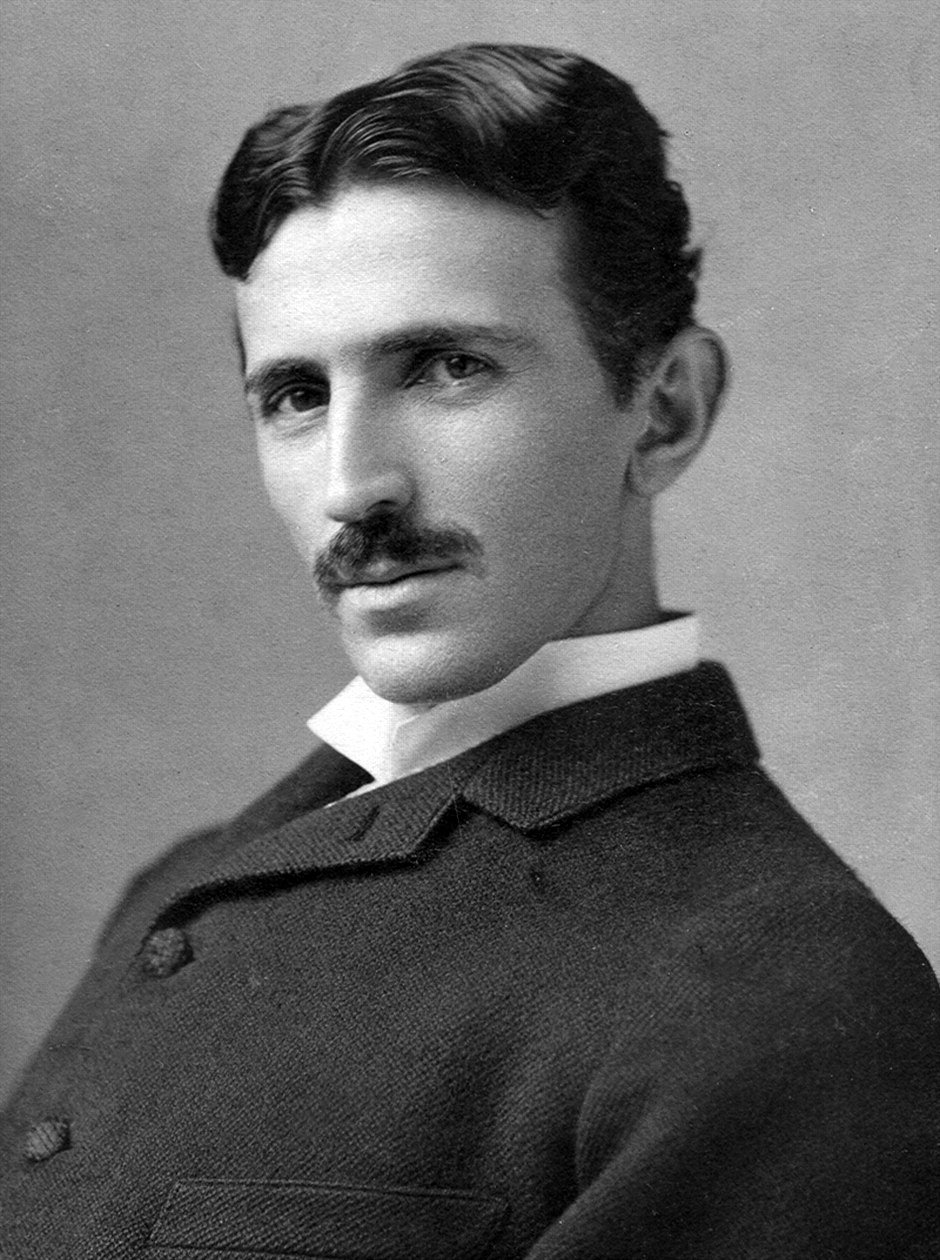
Person: Nikola Tesla
Nikola Tesla was one of the most influential electrical inventors of the late nineteenth and early twentieth centuries. His work helped establish the foundations of modern alternating-current (AC) electricity, electric motors, high-frequency electrical technology, and early wireless experimentation.
Tesla is often portrayed as a mysterious genius who invented almost everything associated with modern electricity. The historical record is more nuanced. He was an extraordinary inventor whose achievements were built within a larger scientific and engineering revolution involving many researchers and engineers. His greatest contribution was developing practical AC motors and polyphase electrical systems that helped make large-scale electrical power transmission possible.
Early Life and Education
Nikola Tesla was born on July 10, 1856, in Smiljan, then part of the Austrian Empire and now located in Croatia. His family was of Serbian background. His father, Milutin Tesla, was a Serbian Orthodox priest and writer, while his mother, Georgina-Djuka Tesla, was known for her practical skills and ability to create household tools despite having little formal education.
Tesla showed an early interest in mathematics, machines, and natural phenomena. He later described an unusually strong ability to visualize mechanical devices in his mind before constructing them. He studied at the Austrian Polytechnic in Graz beginning in 1875, where he became deeply interested in electrical engineering. He later attended the Charles-Ferdinand University in Prague but did not complete a degree. During his student years, electricity was rapidly developing as a scientific and industrial field. Tesla became particularly interested in alternating current and the possibility of using it to operate electric motors.
Early Engineering Career
Tesla began working professionally in Europe, including with a telephone company in Budapest in 1881. He later moved to Paris and worked for the Continental Edison Company, where he gained practical experience with electrical equipment.During this period, Tesla developed ideas involving rotating magnetic fields. These ideas eventually led to his alternating-current induction motor and polyphase electrical system.In 1884, Tesla moved to the United States and arrived in New York carrying a letter of introduction to Thomas Edison.
Tesla and Thomas Edison
Tesla worked briefly for Edison’s organization, helping with electrical machinery and engineering problems. The relationship, however, did not last.Tesla was increasingly interested in alternating current, while Edison’s commercial electrical system was based primarily on direct current (DC). Their professional approaches and business interests differed substantially.Stories about a promised financial bonus and a dramatic personal conflict between the two men have become part of popular culture, but some details are disputed. What is clear is that Tesla left Edison’s company in 1885 and eventually established himself as an independent inventor.Tesla’s later success came largely from developing his own AC technology rather than from continuing Edison’s approach.
The Development of Alternating Current
Tesla’s most important achievement was his development of practical polyphase AC systems. Unlike DC, alternating current periodically changes direction. One major advantage of AC is that transformers can efficiently raise or lower voltage. Electricity can therefore be transmitted at high voltage over long distances and then reduced to safer, useful levels. Tesla’s induction motor was particularly important. Instead of requiring brushes and a direct electrical connection to the rotating part, the motor used a rotating magnetic field to induce motion in the rotor.Tesla received important U.S. patents for his AC system in 1888. His work provided a practical foundation for AC generation, transmission, and motor operation.
The War of the Currents
During the late 1880s and early 1890s, AC and DC became competitors in the rapidly growing electrical industry. This rivalry became known as the “War of the Currents.”Thomas Edison promoted DC, while George Westinghouse became the leading commercial supporter of AC technology. In 1888, Westinghouse licensed Tesla’s AC patents.Tesla worked with Westinghouse engineers and helped develop the technology for practical use. The eventual success of AC was not the work of Tesla alone. Westinghouse, engineers, manufacturers, investors, and many other electrical pioneers contributed to its commercialization.
AC’s ability to transmit electricity efficiently over long distances gave it an important advantage for large electrical networks.
Tesla’s Major Inventions and Experiments
Tesla’s work extended beyond power systems.
The Tesla coil, introduced in 1891, produced very high voltages and high-frequency electrical oscillations. Tesla used it to investigate electrical resonance, wireless transmission, and high-frequency phenomena.He also experimented with wireless communication and electrical energy transmission. In 1898, Tesla publicly demonstrated a radio-controlled boat at Madison Square Garden in New York. The demonstration was an early example of wireless remote control and anticipated later developments in automation and robotics.Tesla also made important contributions to wireless technology, including patents involving tuned electrical circuits. However, the claim that Tesla alone invented radio is misleading. Wireless communication developed through the work of many researchers, including Guglielmo Marconi, Tesla, Heinrich Hertz, and others.
The 1893 World’s Columbian Exposition
The 1893 World’s Columbian Exposition in Chicago became an important demonstration of AC technology.
Westinghouse Electric supplied the electrical system for much of the exposition, while Tesla’s AC motors and electrical technology were prominently demonstrated.Millions of visitors saw AC lighting and electrical machinery operating on a large scale. The success of the exposition strengthened the case for alternating current and helped demonstrate its potential for future power systems.
Niagara Falls and Hydroelectric Power
Tesla’s AC system was also closely associated with the development of the Niagara Falls hydroelectric project.
Westinghouse supplied major electrical equipment for the project, and the first generators began operating in 1895. Electricity generated from the power of Niagara Falls could be transmitted to distant users.
The project demonstrated the practical potential of large-scale hydroelectric generation combined with AC transmission. It became an important milestone in the development of modern electrical power systems.
Colorado Springs and Wardenclyffe
In 1899, Tesla traveled to Colorado Springs, Colorado, where he conducted high-voltage and high-frequency experiments. He investigated electrical resonance, powerful oscillations, and the possibility of transmitting electrical energy wirelessly.
Tesla later pursued an even larger vision at Wardenclyffe Tower on Long Island, New York. Financed initially by J. P. Morgan, the project was intended to support wireless communication and Tesla’s broader ambitions for wireless energy transmission.
The project faced financial and technical difficulties and was never completed as Tesla envisioned. Wardenclyffe ultimately failed commercially, illustrating the difference between Tesla’s ambitious ideas and what could be achieved economically and technically at the time.
Tesla’s Later Years and Death
Tesla continued experimenting and filing patents during his later years, but his financial situation became increasingly difficult. Several ambitious projects failed to produce commercial returns, and he became increasingly isolated.
He spent much of his later life living in New York hotels and remained fascinated by technological possibilities, even when his ideas became increasingly speculative.
Tesla died on January 7, 1943, at the New Yorker Hotel in Manhattan at the age of 86.
Historical Facts vs. Tesla Myths
Tesla’s achievements should not be exaggerated to make his story more impressive.
He did not invent electricity, nor did he single-handedly create the modern electrical grid. Scientists and engineers before and during Tesla’s career developed generators, transformers, electromagnetic theory, and other essential technologies.
He also did not single-handedly invent radio. Tesla made important contributions to wireless technology, but radio emerged through the combined work of numerous researchers and inventors.
Tesla’s Wardenclyffe project also did not successfully provide unlimited free electricity to the world. He experimented seriously with wireless power transmission, but the worldwide system he imagined was never achieved.
These qualifications do not diminish Tesla’s achievements. His AC motor, polyphase electrical system, Tesla coil, wireless experiments, and remote-control demonstration were genuine and historically significant contributions.
Tesla’s Legacy
Nikola Tesla’s greatest legacy can be seen in modern electrical engineering.
Polyphase AC systems and induction motors became fundamental to industrial power and remain important today. His high-frequency experiments influenced later electrical and wireless research, while his remote-controlled boat anticipated technologies that would eventually become common in automation and robotics.
Tesla also became a cultural symbol of invention and imagination. Museums, books, films, scientific institutions, and popular culture continue to celebrate his work.
His life demonstrates both the possibilities and limitations of technological vision. Tesla imagined technologies far beyond his own time, but not every idea could be transformed into a practical or commercially successful system.
His lasting importance rests on the inventions and engineering principles that survived beyond his lifetime. Tesla did not build the modern electrical world alone, but his contributions helped shape it—and that achievement remains a significant part of the history of science and technology.