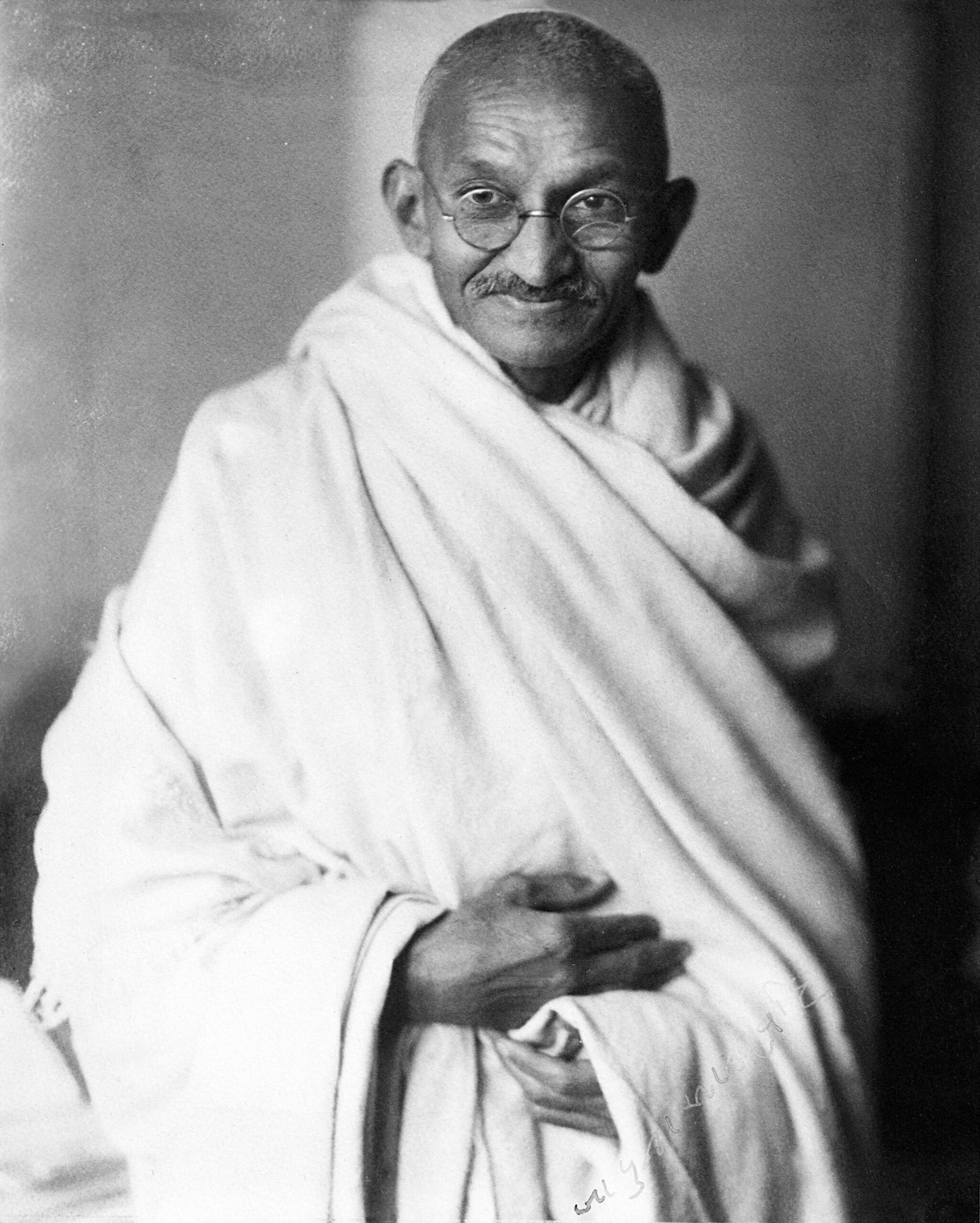
Person: Mahatma Gandhi
Mahatma Gandhi: The Life, Ideas, and Legacy of India’s Freedom Leader
Mahatma Gandhi was one of the most influential political and social leaders of the 20th century. Born Mohandas Karamchand Gandhi on October 2, 1869, in Porbandar, Gujarat, he became a central figure in India’s struggle against British colonial rule and helped turn nonviolent mass protest into a powerful political method. Gandhi did not command an army or hold government office during the main years of the independence struggle. His influence came from a different source: his ability to organize ordinary people around campaigns of nonviolent resistance, civil disobedience, economic self-reliance, and moral pressure.
His political career, however, cannot be reduced to a simple story of heroic leadership. Gandhi’s views changed over time, and some of his positions remain deeply debated. His disagreements with B. R. Ambedkar over caste and political representation, his approach to Hindu-Muslim relations, and aspects of his thinking about race, society, and political strategy have all received serious historical scrutiny. Understanding Mahatma Gandhi therefore means looking at both sides of his historical importance: the extraordinary power of his methods and the limitations, contradictions, and controversies surrounding them.
Early Life and Family
Mohandas Karamchand Gandhi was born in Porbandar, then part of the princely state of Kathiawar in western India. His father, Karamchand Gandhi, served as a senior administrator in several princely states. His mother, Putlibai, was deeply religious and influenced Gandhi’s early understanding of faith, self-discipline, fasting, and moral conduct. Gandhi grew up in a Vaishnava Hindu environment, but his religious outlook was shaped by encounters with several traditions. Jain ideas, particularly the importance of nonviolence, were influential in Gujarat, while later experiences exposed him to Christianity, Islam, Hindu philosophical texts, and other religious traditions.
In 1883, at the age of 13, Gandhi married Kasturba Makhanji, who was also about 13. Their marriage lasted until Kasturba’s death in 1944. They had four sons: Harilal, Manilal, Ramdas, and Devdas. The young Gandhi was not initially an obvious candidate for political leadership. His later transformation came through education, professional experience, religious reflection, and especially his years in South Africa.
Education and Early Career
Gandhi attended schools in Rajkot and later travelled to London to study law. In 1888, he entered the Inner Temple, one of London’s four Inns of Court, and was called to the bar in 1891. His years in Britain exposed him to a wider intellectual and religious environment. He read works that contributed to his developing ideas about morality, religion, vegetarianism, and social responsibility.
After returning to India, Gandhi struggled to establish a successful legal career. In 1893, an opportunity to work for an Indian merchant’s legal case took him to South Africa.
That journey changed the direction of his life.
Gandhi in South Africa
Gandhi spent more than two decades in South Africa, from 1893 until 1914, with interruptions and later visits. It was there that he developed many of the methods and ideas that would later make him famous in India. South Africa’s Indian community faced discriminatory laws and social restrictions. Gandhi himself experienced racial discrimination soon after arriving. One of the best-known incidents occurred when he was removed from a first-class railway compartment at Pietermaritzburg despite holding a valid ticket.
Rather than treating the incident simply as a personal humiliation, Gandhi increasingly became involved in organizing Indians against discriminatory policies.
He established political organizations, wrote extensively, negotiated with officials, and organized campaigns of resistance.
It was during this period that he developed satyagraha, a method of resistance based on truth, moral courage, self-discipline, and nonviolent action.
Gandhi’s South African campaigns were not identical to the later Indian independence movement. They were shaped by the particular circumstances of the Indian community in South Africa. Nevertheless, the experience gave him a practical laboratory in which political protest, community organization, personal discipline, and moral persuasion became connected.
His years in South Africa were therefore crucial to the making of the political Gandhi who returned to India in 1915.
Development of Satyagraha and Nonviolence
Two concepts are particularly important for understanding Gandhi: ahimsa and satyagraha.
Ahimsa
Ahimsa is commonly translated as nonviolence or the avoidance of harm. Gandhi treated it as more than simply refusing to use physical violence. For him, it was connected to respect for human life and an attempt to resist injustice without hatred toward the opponent. His understanding of ahimsa developed over time and became central to his political as well as personal philosophy.
Satyagraha
Gandhi used the term “satyagraha” to describe a form of resistance grounded in truth and moral force. It was different from simply refusing to cooperate with an authority. The satyagrahi, in Gandhi’s conception, accepted personal suffering rather than deliberately inflicting suffering on an opponent. Civil disobedience could therefore involve breaking an unjust law openly and accepting the legal consequences.
This method was intended to expose injustice, mobilize public opinion, and create pressure for change.
Swadeshi
Another important idea was swadeshi, or the use and promotion of locally produced goods.For Gandhi, swadeshi was not merely an economic policy. It was connected to political independence and the development of local communities.The spinning wheel and khadi, hand-spun and hand-woven cloth, became powerful symbols of this approach. Gandhi encouraged Indians to reduce dependence on imported British manufactured goods and to support local production.
Gandhi and India’s Independence Movement
Gandhi returned to India in January 1915. He soon became involved in local struggles and gradually emerged as one of the most important leaders of the Indian National Congress. His political approach differed from earlier forms of elite nationalist politics because he sought to involve large sections of the population. Among the important early campaigns associated with him were struggles involving peasants and workers, including the Champaran movement in Bihar in 1917, the Ahmedabad mill workers’ dispute in 1918, and the Kheda campaign in Gujarat in 1918.
These experiences helped establish Gandhi’s reputation as a leader willing to connect national politics with local grievances.
Non-Cooperation Movement
The Non-Cooperation Movement, launched in 1920, represented a major expansion of Gandhi’s strategy.
The campaign encouraged Indians to withdraw cooperation from British institutions. This included boycotts of government schools, colleges, courts, and imported goods, alongside the promotion of khadi and other constructive activities.
The movement attracted enormous public participation.
However, Gandhi’s insistence on nonviolence created a major strategic tension. In February 1922, violence at Chauri Chaura resulted in the deaths of police personnel after a crowd attacked and burned a police station.
Gandhi concluded that the movement had moved away from his principles and called it off.
The decision disappointed many nationalists who believed the campaign had reached a critical stage. It also demonstrated an important feature of Gandhi’s leadership: he was prepared to suspend a mass political campaign if he believed its methods had become inconsistent with nonviolence.
Civil Disobedience Movement
During the late 1920s, demands for Indian self-government became increasingly forceful.The Indian National Congress declared Purna Swaraj, or complete independence, as its goal in 1929.Gandhi then prepared for a new campaign of civil disobedience.The result was one of the most famous episodes of the Indian independence movement.
Salt March
On March 12, 1930, Gandhi left the Sabarmati Ashram near Ahmedabad with a group of followers and began a march toward the coastal village of Dandi. The journey covered roughly 385 kilometers and lasted 24 days. On April 6, Gandhi reached the coast and broke the British salt law by producing salt. The action was deliberately simple.
Salt was an everyday necessity, which made the issue understandable to people across social and economic divisions. The campaign transformed an apparently ordinary commodity into a symbol of colonial authority and resistance. The Salt March attracted international attention and helped inspire wider acts of civil disobedience across India. Gandhi was arrested in May 1930. The campaign continued through arrests, protests, boycotts, and other forms of resistance. The Gandhi-Irwin Pact of March 1931 temporarily reduced tensions and allowed Gandhi to attend the Second Round Table Conference in London as a representative of the Indian National Congress. The conference did not produce the political settlement Gandhi wanted, and civil disobedience later resumed.
Quit India Movement
The Quit India Movement began in August 1942 during the Second World War. The immediate political background included growing frustration with British rule, the failure of the Cripps Mission, and disagreements over India’s political future during the war.On August 8, 1942, the All-India Congress Committee adopted the Quit India resolution in Bombay. Gandhi called for determined resistance and famously used the phrase “Do or Die.”
The British authorities responded rapidly. Gandhi and other senior Congress leaders were arrested shortly afterward.
Unlike earlier campaigns, the 1942 movement quickly became difficult for Congress’s imprisoned leadership to control. In several parts of India, protests became violent, and government buildings, railway lines, communications systems, and other infrastructure were attacked.
This creates an important historical distinction: Gandhi advocated nonviolent resistance, but not every action carried out in the Quit India Movement was nonviolent.
The British repression was severe, and thousands of people were arrested.The movement did not immediately end British rule. India became independent five years later, in August 1947. Historians continue to debate the precise contribution of Quit India, alongside the war, economic pressures, changing British politics, other nationalist movements, and the activities of leaders such as Subhas Chandra Bose and the Indian National Army.
Gandhi’s Philosophy and Major Ideas
Gandhi’s political thought was not a single fixed doctrine. It developed throughout his life.
Truth
Truth was central to Gandhi’s understanding of politics and personal conduct.
His autobiography, The Story of My Experiments with Truth, reflects his belief that truth should be approached through continuous moral and personal examination.
This explains why Gandhi often described his life as a series of experiments rather than presenting himself as someone who had reached perfect certainty.
Nonviolent Resistance
Gandhi demonstrated that nonviolent protest could be organized on a mass scale.
His methods included:
-
Boycotts
-
Strikes
-
Marches
-
Public demonstrations
-
Refusal to cooperate with authorities
-
Breaking selected laws openly
-
Fasting
-
Economic self-reliance
-
Constructive community work
Nonviolence, however, was not simply a political tactic for Gandhi. He regarded it as a moral principle.
Swadeshi and Khadi
Gandhi saw economic independence as part of political independence.Khadi represented self-reliance, local production, and opposition to the economic structures of colonial rule.For Gandhi, spinning was also intended to connect political action with everyday life.
Constructive Programme
Gandhi believed independence should involve more than transferring political power from British rulers to Indian leaders.He promoted village development, sanitation, education, communal harmony, women’s participation, economic self-reliance, and opposition to untouchability.This part of Gandhi’s work is sometimes overshadowed by the major independence campaigns, but it was central to his vision of what freedom should mean.
Gandhi and Social Reform
Gandhi regarded social reform as inseparable from the struggle for independence.One of his major campaigns was against untouchability, the discriminatory treatment of communities historically placed outside or at the bottom of India’s caste hierarchy.He used the term Harijan, meaning “children of God,” for communities then commonly described as “untouchables.” Many Dalit activists later rejected this terminology, arguing that it could be paternalistic and did not adequately address caste-based power and discrimination.
Gandhi campaigned against practices such as exclusion from temples and social discrimination.However, his approach to caste was complicated.He opposed untouchability and increasingly criticized caste discrimination, but he did not always agree with those who demanded the complete destruction of the caste system.This became particularly important in his relationship with B. R. Ambedkar, one of the most important advocates for Dalit rights and a future architect of India’s Constitution.
Gandhi and B. R. Ambedkar
Gandhi and Ambedkar shared opposition to the oppression of Dalits but differed fundamentally over political representation and the future of caste.Ambedkar argued that oppressed communities needed independent political safeguards and the ability to represent themselves.
Gandhi feared that separate electorates for the “Depressed Classes” would divide Hindu society and opposed the proposal.Their conflict became especially intense in 1932, when Gandhi undertook a fast while imprisoned at Yeravda.The resulting Poona Pact replaced separate electorates with reserved seats for Depressed Classes within a common electorate.The agreement was historically important, but it did not end the disagreement between Gandhi and Ambedkar.
The Gandhi-Ambedkar debate remains essential to understanding the limitations of Gandhi’s social philosophy. Gandhi’s campaign against untouchability was significant, but Ambedkar’s criticism exposed the difference between opposing a discriminatory practice and confronting the deeper structures of caste power.
Gandhi, Hindu-Muslim Relations, and Partition
Gandhi consistently argued for cooperation between India’s religious communities.He regarded Hindu-Muslim unity as essential to Indian nationalism and repeatedly intervened during communal conflicts.His political relationship with Muslim leaders and organizations changed over time, and his support for the Khilafat movement after the First World War was controversial among some contemporaries and later historians.
The collapse of Hindu-Muslim political cooperation and the rise of communal tensions deeply troubled Gandhi.During the violence surrounding Partition in 1947, he spent much of his final period travelling through areas affected by communal conflict, including Noakhali, Bihar, Calcutta, and Delhi.
Rather than participating in the celebrations surrounding independence in Delhi, Gandhi focused on trying to reduce communal violence.
His interventions in Calcutta in August 1947 were widely remembered as an important moment in efforts to stop violence.
Yet Gandhi could not prevent Partition.
India and Pakistan became independent in August 1947, accompanied by one of the largest and most traumatic population movements in modern history.
Millions of people crossed newly created borders, while widespread communal violence caused enormous loss of life.
Gandhi’s opposition to communal hatred remained one of the defining features of his final year, but the fact that Partition occurred also illustrates the limits of his influence.
Criticisms and Historical Debates
Mahatma Gandhi’s historical reputation has changed considerably across generations.
He is internationally celebrated for nonviolent resistance, but serious historical scholarship has also examined his contradictions and disagreements.
Gandhi’s Views on Caste
Gandhi’s opposition to untouchability was significant, but his views on caste and varna evolved and remained contested.Critics, particularly from Dalit perspectives, have argued that Gandhi’s approach did not go far enough in challenging the social structure that produced caste oppression.
Ambedkar was one of Gandhi’s strongest critics on this issue.
The debate cannot be reduced to saying that Gandhi either “supported caste” or “ended caste.” His views changed over time, and the differences between Gandhi and Ambedkar were substantive and political.
Gandhi and Race
Gandhi’s early writings and activities in South Africa contain statements about Africans and racial distinctions that have attracted substantial criticism.It is important not to erase these writings from his biography.At the same time, historians debate how his views changed over the course of his life and how his South African political activity should be understood within the racial and colonial environment of the period.A responsible biography therefore needs to acknowledge both the evidence and the evolution of Gandhi’s thinking rather than presenting a simplified judgment.
Gandhi’s Political Methods
Gandhi’s reliance on fasting and moral pressure has also been debated.
Supporters viewed fasting as a form of personal sacrifice intended to appeal to conscience.
Critics have argued that Gandhi’s moral authority could place significant pressure on political opponents and colleagues.
Similarly, his willingness to suspend movements when violence occurred sometimes frustrated other nationalist leaders who believed political momentum should not be abandoned.
Gandhi Was Not the Only Leader of Independence
Another important correction to simplified accounts is that India’s independence was not achieved by Gandhi alone.The movement involved millions of people and many organizations, political traditions, workers, peasants, students, revolutionaries, constitutionalists, social reformers, women activists, regional leaders, and religious communities.Leaders such as Jawaharlal Nehru, Vallabhbhai Patel, Maulana Abul Kalam Azad, Subhas Chandra Bose, Rajendra Prasad, Sarojini Naidu, Annie Besant, B. R. Ambedkar, and many others played important roles in India’s political transformation.The British withdrawal also reflected the effects of the Second World War, changing international politics, economic pressures, Indian military and political developments, and the weakening of Britain’s ability and willingness to maintain its empire.
Gandhi was central to the independence movement, but independence was the result of a much larger historical process.
Assassination and Final Years
The final years of Gandhi’s life were dominated by communal violence, Partition, and his efforts to promote peace.
He opposed revenge and repeatedly called on Hindus, Muslims, and Sikhs to protect one another.
His interventions often placed him in politically dangerous situations.
On January 30, 1948, Gandhi was assassinated in New Delhi while walking to an evening prayer meeting.
The assassin was Nathuram Godse, a Hindu nationalist who opposed Gandhi’s political approach and particularly objected to what he regarded as Gandhi’s concessions to Muslims.
Gandhi’s assassination shocked India and generated international mourning.
His death came only months after independence and Partition, at a moment when the new Indian state was still struggling with the consequences of communal violence and displacement.
Legacy and Global Influence
Gandhi’s influence extended far beyond India.His methods of nonviolent resistance became important reference points for later movements around the world.Martin Luther King Jr. studied Gandhi’s ideas and incorporated nonviolent resistance into the American civil rights movement. Other activists and political movements have also drawn on Gandhian ideas, although they adapted them to very different political circumstances.Gandhi’s legacy can therefore be understood in several ways.
Political Legacy
He demonstrated how mass participation, civil disobedience, boycotts, and noncooperation could challenge powerful political institutions.
Social Legacy
His campaigns against untouchability, his advocacy of village development, and his emphasis on social responsibility contributed to debates about what political freedom should mean.
Moral Legacy
Gandhi connected political action with questions of personal conduct. He argued that the methods used to achieve a political goal mattered as much as the goal itself.
Global Legacy
The idea that political resistance could be powerful without relying primarily on armed violence became one of Gandhi’s most enduring contributions to modern political thought.
His influence should not, however, be treated as universal or automatic. Nonviolent movements succeed under particular political, social, and institutional conditions, and later movements have adapted Gandhian methods in different ways.