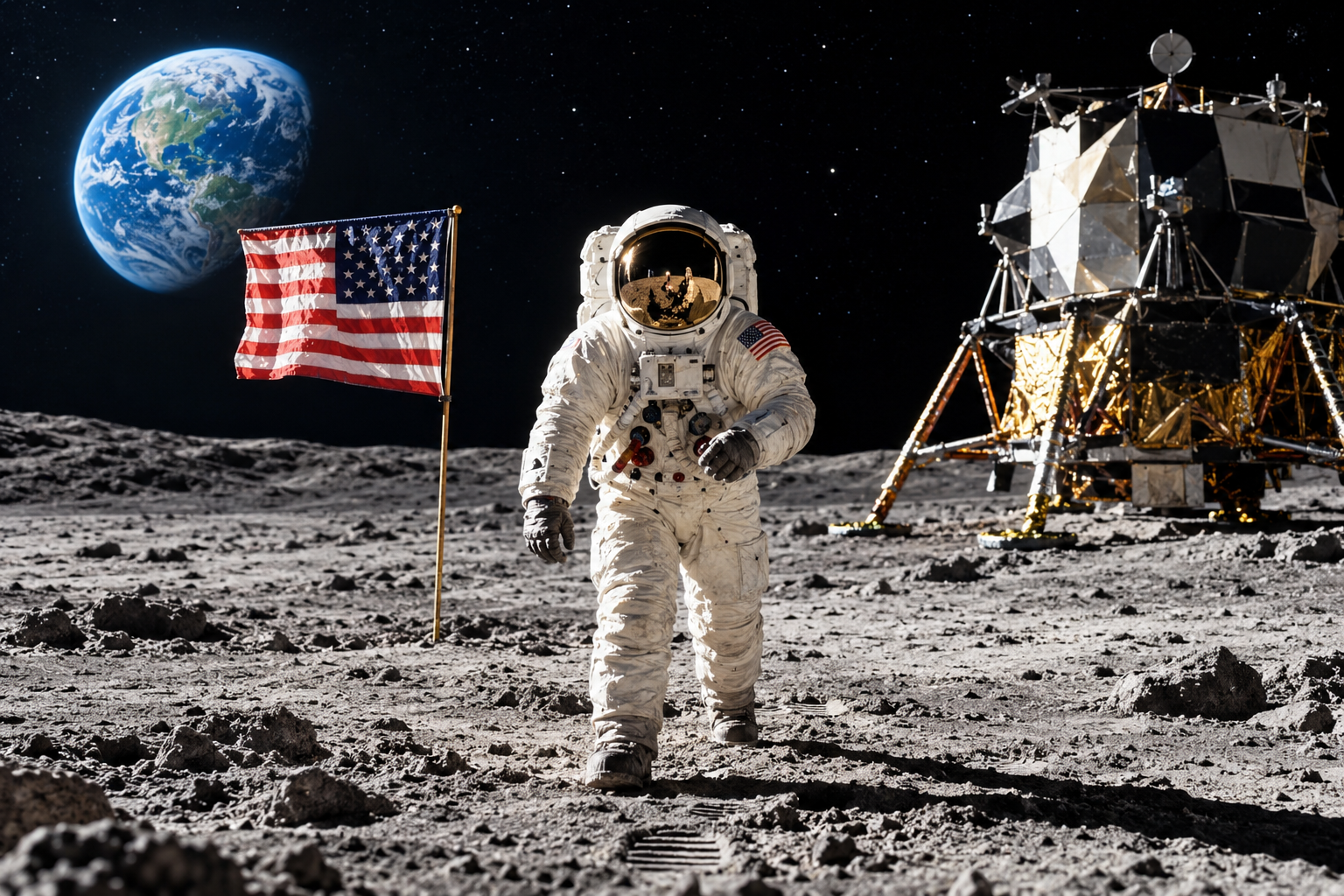
The First Human on the Moon
July 20, 1969,
became one of the most unforgettable dates in human history. On that day, humanity did something that had once seemed impossible: a human being stepped onto the surface of the Moon.
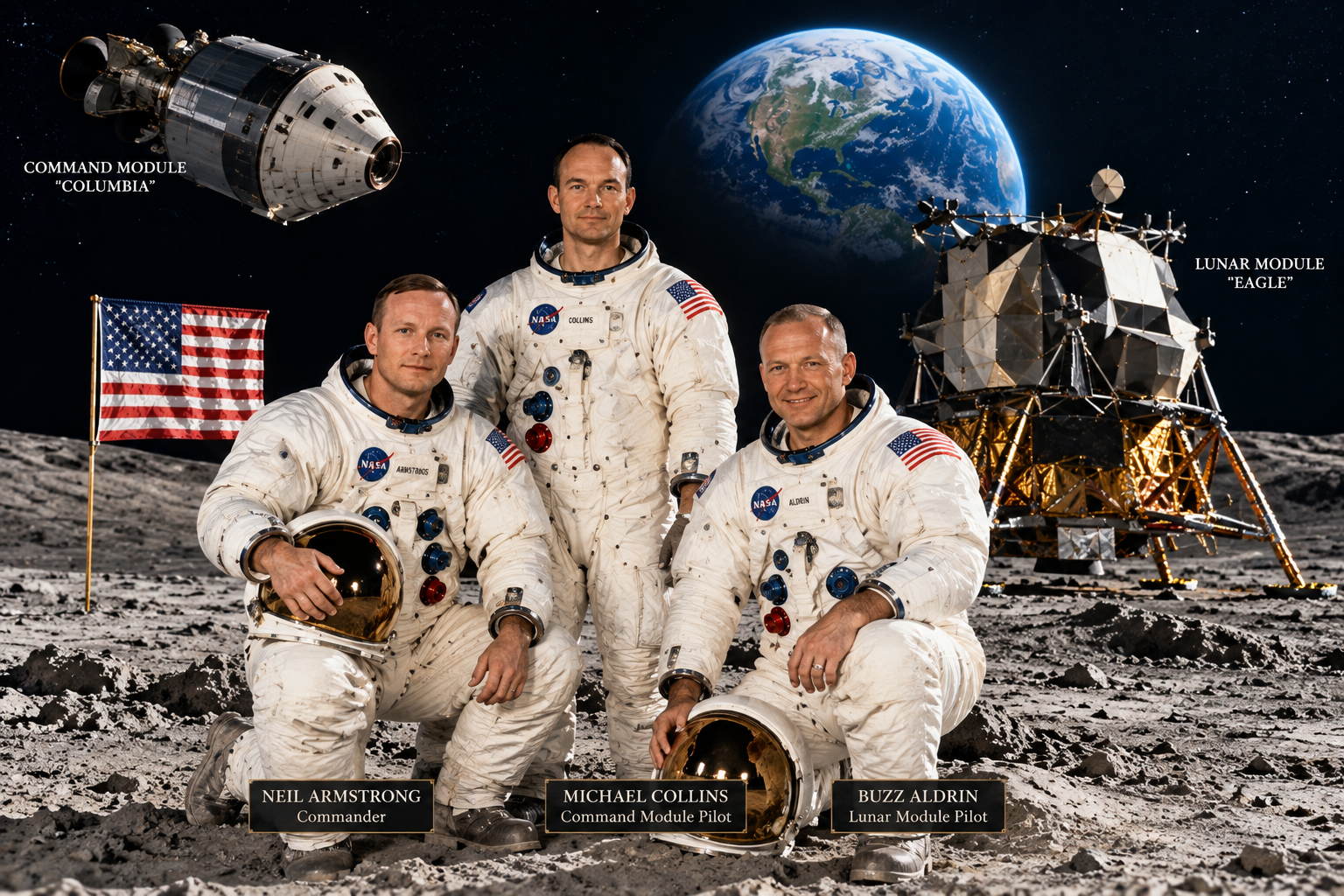
The journey was part of NASA’s Apollo 11 mission, launched from Kennedy Space Center in Florida on July 16, 1969. Three astronauts were aboard the spacecraft: Neil Armstrong, Buzz Aldrin, and Michael Collins.
Their mission was simple to describe but incredibly difficult to accomplish — land humans on the Moon and bring them safely back to Earth.
A Journey Beyond Earth
Millions of people around the world watched as the massive Saturn V rocket lifted Apollo 11 into space. Armstrong, Aldrin, and Collins were beginning a journey of more than 380,000 kilometers from Earth.
After several days of travel, Apollo 11 reached lunar orbit. Armstrong and Aldrin then entered the lunar module, Eagle, while Collins remained in the command module, Columbia, orbiting the Moon.
The landing was one of the most tense moments of the mission.
As Eagle descended toward the lunar surface, the astronauts saw that the computer’s planned landing area contained dangerous rocks and craters. Armstrong took manual control and searched for a safer place to land.
With fuel running low, Eagle finally touched the Moon.
Armstrong reported:
“The Eagle has landed.”
For the first time, human beings had reached another world.
One Small Step
Several hours later, Neil Armstrong climbed down the ladder of the lunar module.
He slowly placed his left foot onto the dusty surface of the Moon.
At that moment, history changed.
Armstrong spoke the famous words:
“That’s one small step for man, one giant leap for mankind.”
Buzz Aldrin soon joined him on the surface. Together, the two astronauts spent about two and a half hours outside the lunar module, collecting rock and soil samples, taking photographs, setting up scientific equipment, and documenting their surroundings.
The Moon looked completely different from Earth. There was no wind, no rain, and no atmosphere like the one we experience here. The astronauts moved carefully across the surface in their bulky spacesuits, leaving footprints in the fine lunar dust.
Those footprints remain on the Moon today.
Millions Watched From Earth
Back on Earth, people gathered around television sets to watch the historic event.
Families stayed awake late into the night. Children watched with their parents. People in different countries followed the mission through radio and television broadcasts.
For many, it was difficult to believe that the images appearing on their screens were real.
A human being was standing on the Moon.
The achievement was not just a victory for NASA or the United States. It represented a major moment in the history of human exploration.
For centuries, people had looked at the Moon from Earth and wondered what it would be like to go there. In 1969, that dream became reality.
The Return Home
After completing their work on the Moon, Armstrong and Aldrin returned to the lunar module and launched from the surface.
They reunited with Michael Collins in lunar orbit before beginning the journey back to Earth.
On July 24, 1969, Apollo 11 safely splashed down in the Pacific Ocean.
The three astronauts had completed a journey that changed the way humanity looked at space—and at itself.
A Moment That Still Lives
The first moon landing happened more than half a century ago, but its importance has not disappeared.
The footprints left by Armstrong and Aldrin are still preserved on the lunar surface. The rocks they collected continue to be studied by scientists. And the photographs from Apollo 11 remain some of the most recognizable images in the history of exploration.
Neil Armstrong later described the experience as a moment that belonged not just to him but to humanity.
The moon had always been a distant light in the night sky.
On July 20, 1969, it became a place where humans had walked.
The journey to the Moon proved something powerful: sometimes the greatest discoveries begin with the courage to go somewhere no one has gone before.

