Outbreak of World War II: How the Second World War Began
Introduction
World War II began in Europe on 1 September 1939, when Nazi Germany invaded Poland. Two days later, on 3 September 1939, Britain and France declared war on Germany after Germany refused to withdraw its forces.
The outbreak of the war marked one of the most significant turning points in modern history. Within months, a conflict that began with the destruction of Polish independence had developed into a wider European war. Over the following years, the conflict would spread across continents and oceans, eventually involving dozens of countries.
The invasion of Poland is generally regarded as the immediate trigger of World War II in Europe, but it was not the only cause. The war resulted from years of political instability, unresolved tensions following World War I, economic crises, aggressive nationalism, the rise of Nazi Germany, military expansion, the weakness of collective security, and the failure of diplomacy to contain German aggression.
To understand how World War II began, it is therefore necessary to examine both the long-term developments that created the conditions for war and the events that finally brought Europe into open conflict in September 1939.
Europe After World War I
World War I ended in November 1918 after four years of devastating warfare. Millions of soldiers and civilians had been killed, and much of Europe had suffered enormous economic and physical destruction.
The war also transformed the political map of Europe.
The German, Austro-Hungarian, Ottoman, and Russian empires collapsed or were fundamentally transformed. New countries emerged, while existing borders were redrawn. Governments attempted to establish a new international order based partly on national self-determination and collective security.
Germany became a republic known as the Weimar Republic.
The new German government inherited serious problems. The country faced military restrictions, territorial losses, economic difficulties, political violence, and widespread dissatisfaction with the peace settlement.
The political environment was also unstable. Revolutionary movements on the left and nationalist movements on the right challenged the new democratic system.
Across Europe, governments faced the difficult task of maintaining political stability while dealing with the economic and social consequences of the war.
The League of Nations was created as part of the postwar international system. Its purpose was to encourage cooperation between countries and prevent future wars through collective security and diplomacy.
However, the League had important weaknesses. It lacked its own military force and depended on member states to enforce its decisions. Major powers were often reluctant to risk military confrontation over international disputes.
The peace established after World War I therefore contained unresolved problems that would become increasingly serious during the following two decades.
The Treaty of Versailles and Rising Tensions
The Treaty of Versailles, signed on 28 June 1919, established the main terms of peace between Germany and the Allied powers.
Germany lost territory in Europe and its overseas colonies. Its armed forces were heavily restricted, and the treaty included provisions concerning German responsibility for the war and compensation for wartime damage.
The treaty became deeply unpopular among many Germans.
Nationalists described it as a dictated peace and argued that Germany had been unfairly treated. Political opponents of the Weimar Republic used resentment over Versailles to attack the democratic government.
The treaty alone, however, did not cause World War II.
Germany’s later political and economic problems resulted from a combination of factors. The country experienced severe economic difficulties during the early 1920s, including the catastrophic inflation of 1923.
Some economic stability returned later in the decade, but the Great Depression, which began in 1929, caused another major crisis.
Unemployment increased dramatically, businesses failed, and many people lost confidence in established political institutions.
The economic crisis contributed to political radicalization throughout Europe. In Germany, extremist parties gained support by promising decisive action and national recovery.
The Nazis were particularly successful in exploiting anger over unemployment, political instability, communism, the Treaty of Versailles, and Germany’s perceived loss of national power.
The Rise of Nazi Germany
Adolf Hitler and the National Socialist German Workers’ Party, commonly known as the Nazi Party, emerged as a powerful political force during the crisis of the Weimar Republic.
Hitler had attempted to seize power through the Beer Hall Putsch of 1923, but the attempt failed.
Afterward, the Nazi movement increasingly pursued power through elections and political maneuvering.
The Great Depression transformed the political situation. Millions of Germans faced unemployment and economic insecurity, while governments struggled to respond effectively.
The Nazi Party presented itself as a movement capable of restoring German strength and national unity.
Its propaganda appealed to nationalism, antisemitism, racism, opposition to communism, and resentment toward the postwar settlement.
Hitler was appointed Chancellor of Germany on 30 January 1933.
He did not immediately become an absolute dictator simply through an election. Instead, his government used legislation, political repression, intimidation, violence, and the destruction of democratic institutions to eliminate political opposition.
By 1934, Hitler had established a dictatorship.
Nazi ideology was based on racial hierarchy, antisemitism, extreme nationalism, authoritarian government, and territorial expansion.
Hitler sought to overturn the post-World War I settlement and expand German territory. Nazi leaders also promoted the concept of Lebensraum, or “living space,” particularly in Eastern Europe.
Expansion was therefore not simply a consequence of diplomatic misunderstandings. It was an important part of Nazi ideology and foreign policy.
Germany’s Expansion Before the War
Once Hitler had consolidated power, Germany began challenging the restrictions imposed after World War I.
Several major events demonstrated the growing aggressiveness of German foreign policy.
Remilitarization of the Rhineland
On 7 March 1936, German troops entered the Rhineland.
The region had been demilitarized under the postwar agreements. Germany’s decision to send troops into the area therefore represented a direct challenge to the existing international order.
Britain and France did not respond with military force.
The success of the move strengthened Hitler’s position inside Germany and encouraged the Nazi leadership to believe that further challenges to the European settlement might also succeed without provoking a major war.
Anschluss with Austria
In March 1938, Germany annexed Austria in an event known as the Anschluss.
German troops entered Austria, and the country was incorporated into Nazi Germany.
The annexation expanded German territory and population and demonstrated that Hitler was prepared to use political pressure and military force to change Europe’s borders.
The Sudetenland Crisis
Hitler’s attention then turned toward Czechoslovakia.
The Sudetenland, a border region containing a large German-speaking population, became the focus of German demands.
Hitler claimed to be defending ethnic Germans living in the region.
However, the crisis was part of a broader strategy that threatened the survival of Czechoslovakia itself.
Britain and France feared that resisting Germany could result in another major European war.
The Munich Agreement
In September 1938, British Prime Minister Neville Chamberlain, French Prime Minister Édouard Daladier, German leader Adolf Hitler, and Italian leader Benito Mussolini met in Munich.
The resulting Munich Agreement, signed on 30 September 1938, allowed Germany to take the Sudetenland from Czechoslovakia.
The Czechoslovak government was not given an equal role in deciding its country’s future.
Britain and France hoped that accepting Germany’s demands would satisfy Hitler and prevent a wider war.
The agreement temporarily achieved that goal. Europe did not go to war over the Sudetenland in 1938.
However, the settlement did not resolve the underlying problem.
Occupation of Czechoslovakia
The weakness of the Munich settlement became clear within months.
In March 1939, German forces occupied the Czech lands.
Slovakia became a separate state closely associated with Germany, while the Czech territories were brought under German control.
This was a critical turning point.
Hitler’s actions could no longer easily be interpreted as simply uniting German-speaking populations with Germany. Germany had now occupied territory beyond the areas it claimed on the basis of German ethnicity.
The destruction of Czechoslovakia convinced many British and French leaders that Hitler’s ambitions were considerably broader than previously believed.
The Failure of Appeasement
The policy used by Britain and France to avoid confrontation with Germany during the 1930s is commonly known as appeasement.
Appeasement developed from several understandable concerns.
Britain and France had suffered enormous casualties during World War I. Their leaders and populations strongly feared another major European conflict.
There were also military and economic considerations.
Britain needed time to strengthen its armed forces, particularly its air defenses. France faced political and military difficulties of its own.
Some British leaders also believed that certain German grievances arising from the postwar settlement might be addressed through negotiation.
The Munich Agreement represented the most famous example of this approach.
However, the occupation of the Czech lands in March 1939 seriously damaged the argument that Hitler’s territorial demands could be satisfied through limited concessions.
Britain and France subsequently took a stronger position toward Poland.
Britain provided a guarantee of support for Polish independence, while France also had existing commitments to Poland.
The diplomatic situation had therefore changed significantly by the spring of 1939.
Germany’s next major move would risk a direct confrontation with Britain and France.
The Nazi-Soviet Pact
By the summer of 1939, European diplomacy had entered a critical stage.
Britain and France attempted to reach an understanding with the Soviet Union concerning resistance to further German expansion.
Those negotiations did not produce the agreement the Western powers wanted.
At the same time, Nazi Germany and the Soviet Union unexpectedly moved toward an agreement.
On 23 August 1939, German Foreign Minister Joachim von Ribbentrop and Soviet Foreign Minister Vyacheslav Molotov signed the German-Soviet Non-Aggression Pact, commonly known as the Molotov-Ribbentrop Pact.
The public agreement committed Germany and the Soviet Union not to attack each other.
The more significant arrangements were contained in a secret protocol.
This protocol divided much of Eastern Europe into German and Soviet spheres of influence. Poland was to be divided between the two powers, while other territories, including the Baltic states, were assigned within their respective spheres.
The agreement was remarkable because Nazi Germany and the Soviet Union were ideological enemies.
The pact was primarily a strategic arrangement rather than an expression of political friendship.
For Hitler, it reduced the immediate danger of a war against the Soviet Union while Germany attacked Poland.
For Stalin, the agreement provided time to prepare the Soviet Union for a future conflict and created an opportunity to expand Soviet influence and territory in Eastern Europe.
The pact was therefore extremely important to the outbreak of war.
It removed a major obstacle to Hitler’s plans against Poland and established the framework for the division of Polish territory.
Germany Invades Poland
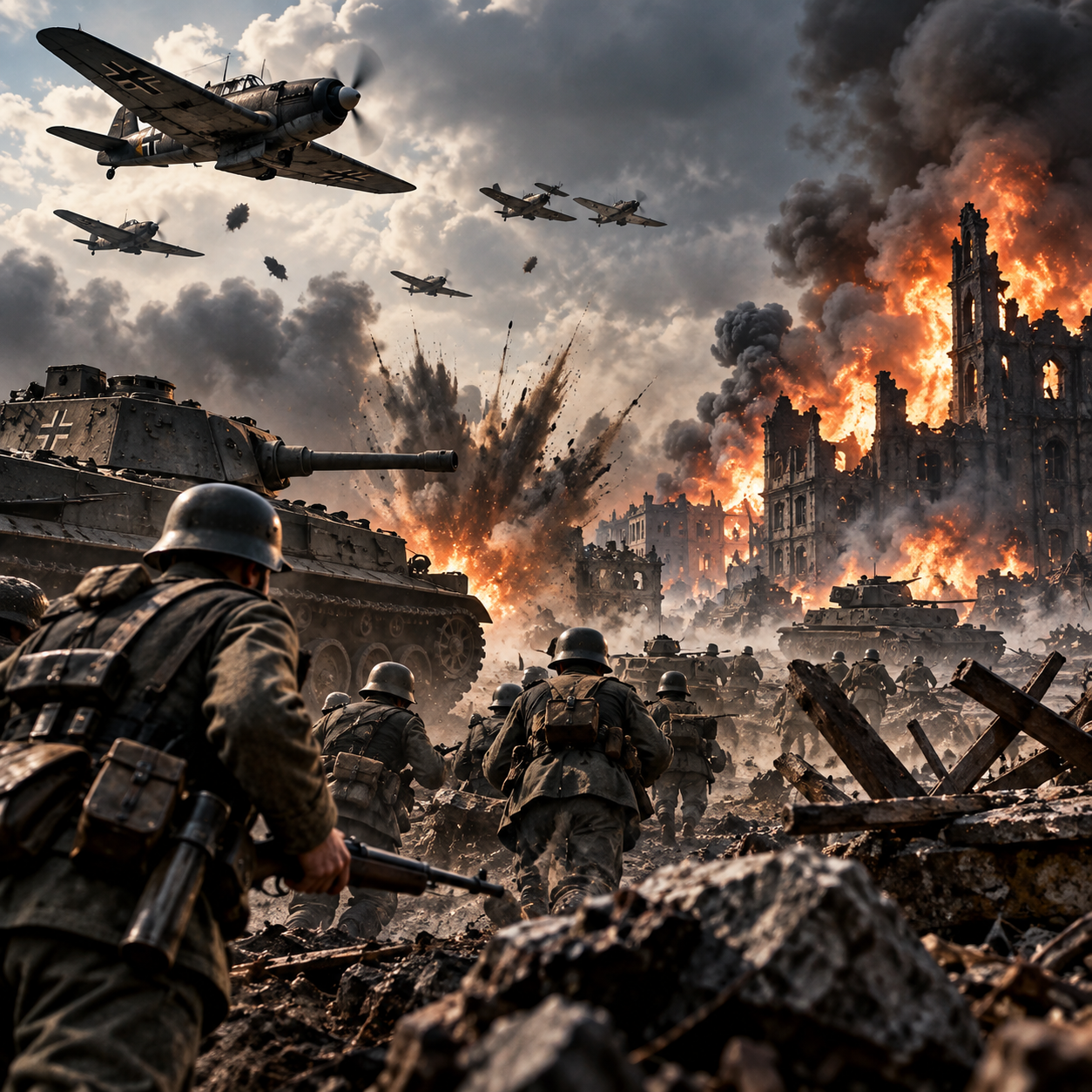
On 1 September 1939, German forces invaded Poland.
The attack began from several directions, with German forces advancing from Germany, East Prussia, and territory controlled by Germany’s allies.
German aircraft attacked targets across Poland while ground forces moved rapidly into Polish territory.
The German government attempted to justify the invasion through propaganda, claiming that Poland had committed acts of aggression against Germany and that ethnic Germans in Poland were being threatened.
These claims were used to create a justification for an invasion that had already been planned.
Poland resisted the German attack, but its military position was extremely difficult.
Germany possessed substantial military advantages and was able to concentrate forces against Poland while benefiting from the strategic situation created by the Nazi-Soviet Pact.
The invasion also demonstrated the increasingly aggressive nature of German foreign policy.
Germany was no longer simply demanding revisions to the Treaty of Versailles.
It was using military force to destroy the independence of another European state.
Poland was strategically important because of its geographical position in Central and Eastern Europe.
The country stood between Germany and territories further east and had become a major focus of the European diplomatic crisis.
The German invasion therefore represented a decisive escalation.
Britain and France Declare War
Britain and France had warned Germany that an attack on Poland would have serious consequences.
When German forces invaded Poland on 1 September 1939, the British and French governments demanded that Germany withdraw.
Germany did not comply.
On 3 September 1939, Britain declared war on Germany.
France declared war on Germany later the same day.
These declarations transformed the German-Polish conflict into a wider European war.
Britain and France were not immediately capable of saving Poland through a large-scale military intervention.
Nevertheless, their declarations were strategically and politically significant.
Hitler’s Germany was now at war with the major Western European powers.
The conflict was no longer limited to Poland.
The European international system had entered a general war.
The Soviet Invasion of Eastern Poland
The German invasion was followed by another invasion from the east.
On 17 September 1939, Soviet forces entered eastern Poland.
The Soviet action was closely connected to the secret arrangements of the German-Soviet Pact.
Poland was consequently attacked from two directions.
The Polish government and military were now confronted by German forces in the west and Soviet forces in the east.
The Soviet leadership presented its intervention as necessary to protect populations in territories that it claimed had been left without effective Polish authority.
However, the Soviet invasion also reflected Soviet territorial and strategic objectives and was consistent with the arrangements previously made with Nazi Germany.
The Soviet Union occupied large areas of eastern Poland.
The German and Soviet governments subsequently formalized the division of Polish territory between them.
The destruction of Poland demonstrated the practical consequences of the Nazi-Soviet agreement.
It also shows why the opening phase of World War II cannot be understood simply as Germany fighting Britain and France.
During September 1939, Nazi Germany and the Soviet Union were temporarily cooperating in the destruction and division of the Polish state.
That cooperation would eventually collapse.
Germany would later invade the Soviet Union, transforming the two temporary partners into bitter enemies.
The Phoney War
After Poland was defeated, the war entered a strange phase on the Western Front.
Britain and France were officially at war with Germany, but there was initially little major ground fighting between the Western Allies and German forces.
This period became known in Britain as the “Phoney War” and in France as the “Drôle de guerre,” meaning “strange war.”
The term reflected the contrast between the formal declaration of war and the relative absence of major military operations in Western Europe.
Britain sent the British Expeditionary Force to France.
French forces remained largely in defensive positions, particularly around the fortified Maginot Line.
Germany also did not immediately launch its main offensive against France and the Low Countries.
However, the war was far from inactive.
Naval warfare was already taking place in the Atlantic.
German submarines threatened Allied shipping, while Britain prepared for a prolonged conflict.
Governments also introduced wartime measures affecting civilian populations.
In Britain, children were evacuated from major cities because of fears of German bombing.
The apparent calm on the Western Front ended in April 1940, when Germany invaded Denmark and Norway.
On 10 May 1940, German forces launched a major offensive against the Netherlands, Belgium, Luxembourg, and France.
The period of limited fighting was over.
Germany’s rapid military victories in Western Europe would soon transform the character of the war.
Why World War II Began
World War II had several interconnected causes.
It is important to distinguish between long-term causes, contributing factors, and the immediate trigger.
Long-Term Causes
The long-term background included:
- The political instability created by the aftermath of World War I
- Resentment toward the Treaty of Versailles
- Economic instability and the Great Depression
- Weaknesses in collective security
- The rise of authoritarian governments
- Aggressive nationalism
- Militarization and rearmament
- Territorial disputes
- The failure of international institutions to prevent aggression
None of these factors alone made another world war inevitable.
Their importance came from the way they interacted with one another.
The Rise of Nazi Germany
The rise of Hitler was particularly important.
Nazi ideology rejected the postwar European settlement and promoted German expansion.
Hitler’s government deliberately pursued policies that increased the likelihood of war.
The remilitarization of the Rhineland, annexation of Austria, destruction of Czechoslovakia, and pressure against Poland formed part of an increasingly aggressive pattern.
Expansionist Policies
Germany’s foreign policy became increasingly territorial.
Hitler’s government sought to expand German power in Central and Eastern Europe.
The concept of Lebensraum gave Nazi expansion a broader ideological purpose.
The goal was not simply to revise individual treaty provisions but to establish German dominance over a large part of Europe.
Failure of Diplomacy and Appeasement
Britain and France attempted to preserve peace through negotiation.
The policy of appeasement temporarily avoided war, but it failed to restrain Hitler’s ambitions.
The occupation of Czechoslovakia in March 1939 was particularly important because it demonstrated that German expansion could not be contained simply by satisfying limited territorial demands.
The Nazi-Soviet Pact
The German-Soviet Pact of August 1939 created the immediate strategic conditions for Germany’s attack on Poland.
It reduced the danger of a German-Soviet war while Germany attacked Poland and secretly divided much of Eastern Europe between Germany and the Soviet Union.
The Immediate Trigger: The Invasion of Poland
The immediate trigger for the outbreak of World War II in Europe was the German invasion of Poland on 1 September 1939.
Britain and France had committed themselves to supporting Poland.
When Germany invaded and refused to withdraw, Britain and France declared war on Germany on 3 September 1939.
The invasion of Poland therefore transformed years of international tension into a general European war.
It is important, however, not to confuse the trigger with the complete cause.
The invasion was the event that set the wider war in motion, but the conditions that made such a war possible had developed over many years.
Conclusion
The outbreak of World War II was the result of a long and complicated breakdown of the European international order.
World War I had left unresolved political, territorial, and economic problems. The Treaty of Versailles became a powerful source of German resentment, while the Great Depression weakened democratic governments and encouraged political extremism.
The rise of Adolf Hitler and Nazi Germany fundamentally changed the situation.
Hitler’s government rejected the postwar settlement, rebuilt Germany’s military power, remilitarized the Rhineland, annexed Austria, dismantled Czechoslovakia, and eventually demanded major concessions from Poland.
Britain and France attempted to prevent another catastrophic European war through diplomacy and appeasement. The Munich Agreement temporarily preserved peace, but Germany’s occupation of the Czech lands demonstrated that Hitler’s ambitions went far beyond the reunification of German-speaking populations.
The Nazi-Soviet Pact of August 1939 then created the strategic conditions for Germany to attack Poland.
On 1 September 1939, German forces invaded Poland.
On 3 September, Britain and France declared war on Germany.
On 17 September, Soviet forces entered eastern Poland, completing the division of Poland between Nazi Germany and the Soviet Union.
The conflict that began in Europe would soon grow far beyond its initial boundaries. Germany’s subsequent campaigns, the expansion of the war into Northern and Western Europe, and eventually the involvement of the Soviet Union, United States, Japan, and many other countries transformed the conflict into a truly global war.
The outbreak of World War II was therefore not caused by one treaty, one economic crisis, or one diplomatic failure. It resulted from the interaction of political instability, economic hardship, aggressive nationalism, authoritarian rule, German expansionism, failed diplomacy, and the weakness of collective security.
The invasion of Poland on 1 September 1939 was the immediate trigger, but the road to war had been developing for many years.