Person: Bob Beamon
Bob Beamon’s Long Jump
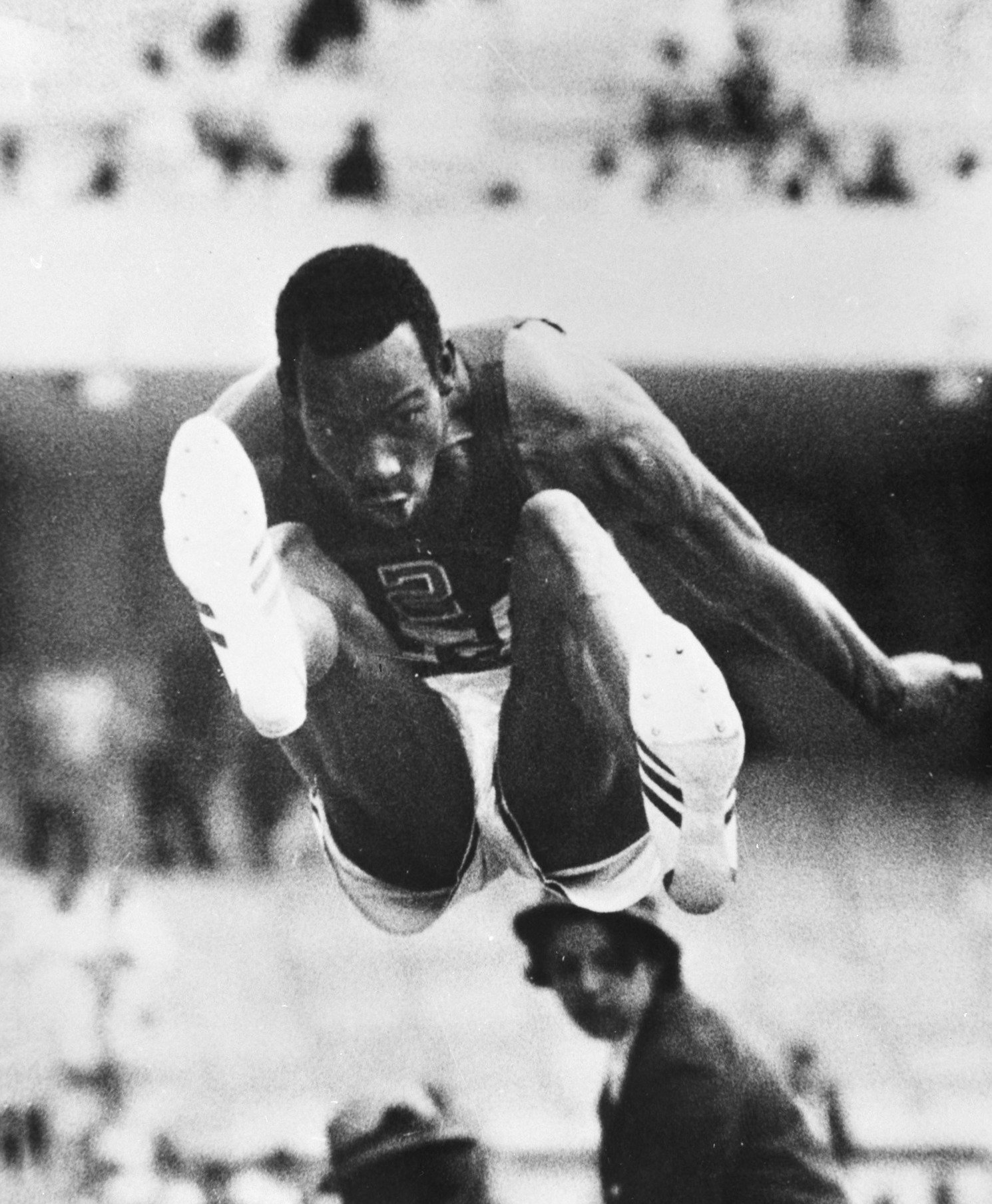
On 18 October 1968, American athlete Bob Beamon produced one of the most remarkable performances in Olympic history. At the Mexico City Olympics, he leaped 8.90 meters in the men’s long jump, setting a world record that stood for nearly 23 years. His extraordinary achievement stunned spectators, competitors, and officials, becoming one of the defining sporting moments of the twentieth century.
Achievement: Olympic gold medal and world-record long jump of 8.90 meters
Historical Significance: Beamon’s record stood until 1991, and his distance remains the Olympic record in the men’s long jump.
The Athlete Behind the Record
Robert Beamon, known as Bob Beamon, was born on 29 August 1946 in Queens, New York, United States. He developed into an outstanding long jumper through his speed, explosive power, and athletic ability.
The long jump is a demanding track-and-field event that combines sprinting speed, precise timing, take-off technique, and body control. Competitors sprint down a runway, launch themselves from a take-off board, and attempt to land as far as possible in a sandpit. Even a small technical error can invalidate a jump.
By 1968, Beamon had established himself as a leading American long jumper. He entered the Mexico City Olympics with the potential to win a medal, but few could have predicted the extraordinary distance he was about to achieve.
A Difficult Start at the Mexico City Olympics
The 1968 Summer Olympics brought together many of the world’s finest athletes. The men’s long jump competition was particularly competitive, featuring experienced jumpers who had spent years challenging the world record.
Beamon’s path to the final was not straightforward. During the qualifying round, he fouled his first two attempts by failing to make a valid jump from the take-off board. With the pressure mounting, he needed a successful third attempt to qualify for the final.
He managed to produce a valid jump and secured his place in the next round.
That narrow escape made what happened in the final even more remarkable. Beamon had overcome a difficult qualifying session and was now ready to compete for an Olympic medal.
18 October 1968: The Historic Leap
On 18 October 1968, Beamon took his place in the men’s long jump final at the Olympic stadium in Mexico City.
When he began his first attempt, he accelerated down the runway and launched himself into the air. His jump carried him far beyond the distances normally associated with elite competition.
Officials struggled to establish the measurement because the result exceeded the range of the electronic measuring equipment available at the time. A manual measuring tape had to be brought in to determine the distance.
Eventually, the scoreboard displayed the result: 8.90 metres, equivalent to approximately 29 feet 2½ inches.
Beamon had broken the previous world record by an astonishing 55 centimetres. In an event where record improvements are often measured in just a few centimetres, the margin was extraordinary.
The scale of the achievement was difficult to comprehend. Beamon himself initially struggled to understand the distance, and the reaction around the stadium reflected the significance of what spectators had witnessed.
His first jump was enough to secure the Olympic gold medal. No other competitor came close to matching his performance.
Why the 8.90-Metre Jump Was So Extraordinary
To understand Beamon’s achievement, it is important to consider the history of the men’s long jump.
In 1935, American athlete Jesse Owens established a world record of 8.13 metres. His performance became one of the great achievements in athletics and remained a benchmark for decades.
By the time of the 1968 Olympics, the world record stood at 8.35 metres, shared by American jumper Ralph Boston and Soviet athlete Igor Ter-Ovanesyan.
Beamon’s jump of 8.90 metres surpassed that mark by 55 centimetres in a single attempt.
The difference was remarkable because elite long jumpers train for years to gain even a small improvement in distance. Beamon’s performance transformed the record and established a new standard that appeared almost impossible to reach.
His leap became a symbol of extraordinary athletic achievement and demonstrated how dramatically an athlete can exceed existing expectations.
Mexico City’s Altitude and the Conditions
The location of the 1968 Olympics played a role in the conditions under which Beamon competed.
Mexico City lies approximately 2,240 metres above sea level. At this altitude, the thinner air produces less aerodynamic resistance, which can benefit athletes in explosive events such as sprinting and the long jump.
Beamon also benefited from a tailwind of 2.0 metres per second, the maximum wind assistance permitted for a record to be recognised under the rules.
These conditions provide important context for understanding the performance. However, they do not diminish the athletic ability, speed, power, and technical execution required to achieve such an exceptional distance.
Beamon’s jump was valid under the competition rules, and the result remains officially recognised as the Olympic record in the men’s long jump.
The Olympic Medal Winners
The men’s long jump final produced three medal winners.
Gold: Bob Beamon, United States — 8.90 metres
Silver: Klaus Beer, East Germany — 8.19 metres
Bronze: Ralph Boston, United States — 8.16 metres
Beamon’s winning distance exceeded the silver-medal result by 71 centimetres. This gap illustrates the extraordinary difference between his performance and those of the other leading competitors.
Ralph Boston was particularly familiar with the event’s history, having previously held the world record. His presence among the medal winners made the competition even more memorable.
A World Record That Lasted Nearly 23 Years
After the Mexico City Olympics, Beamon’s achievement became one of the most famous records in athletics. Leading long jumpers continued to challenge the mark, but nobody surpassed 8.90 meters for almost 23 years.
The word “beamonesque” entered sporting vocabulary to describe an achievement that exceeds expectations by an extraordinary margin.
The record was finally broken on 30 August 1991, at the World Athletics Championships in Tokyo, Japan. American athlete Mike Powell jumped 8.95 meters, improving on Beamon’s world record by five centimeters.
Powell’s performance ended Beamon’s reign as world-record holder. Nevertheless, Beamon’s 8.90-meter jump remains the Olympic record, preserving its place among the most enduring achievements in Olympic athletics.
Bob Beamon’s Legacy
Bob Beamon’s historic leap became much more than a sporting statistic. It demonstrated the importance of preparation, concentration, resilience, and the ability to perform under pressure.
His journey included the uncertainty of two fouled qualifying attempts, followed by a performance that surpassed the existing world record by an unprecedented margin.
The achievement also became closely associated with the Mexico City Olympics, a Games remembered for remarkable athletic performances and significant historical events beyond the stadium.
For generations of athletes and sports fans, Beamon’s jump has represented the possibility of surpassing what was previously considered achievable. It remains an example of how one exceptional performance can change the history of a sport.
Bob Beamon’s long jump on 18 October 1968 was one of the defining sporting moments of the twentieth century. With a distance of 8.90 meters, he broke the world record by 55 centimeters, won Olympic gold, and established a mark that remained unbeaten until 1991.
Although Mike Powell eventually surpassed the world record, Beamon’s achievement continues to occupy a special place in Olympic history. His jump remains the men’s long-jump Olympic record and a lasting example of extraordinary athletic performance.
More than half a century later, Bob Beamon’s leap continues to inspire athletes and sports fans around the world. It stands as a reminder that, sometimes, a single moment can change the history of sport.
Historical Sources and Further Reading
-
World Athletics—Historical coverage of Bob Beamon’s 8.90-meter world record and its fiftieth anniversary.
-
World Athletics—Historical coverage of Mike Powell’s record-breaking 8.95-meter-long jump at the 1991 World Championships.
-
Olympedia—Bob Beamon’s athlete profile and the official results of the 1968 Mexico City Olympic Games.
-
Olympic.com — Historical information about the Mexico City 1968 Olympic Games and its athletics competitions.