Microsoft: The Company That Changed Personal Computing
In the 1970s, computers were still mostly machines for universities, large companies, and government institutions. They were expensive, enormous, and complicated to operate. Then a new generation of smaller computers began to appear, opening the door to something that would eventually change everyday life. One of the first important microcomputers was the Altair 8800, launched in 1975. Unlike the giant mainframe computers that came before it, the Altair was small enough for hobbyists to own, although assembling and using it still required considerable technical knowledge. Two young computer enthusiasts, Bill Gates and Paul Allen, saw an opportunity.
Gates, who was 19, and Allen, who was 20, developed a version of the BASIC programming language that allowed Altair users to write and run programs more easily. Their partnership became known as Microsoft. The hyphen was eventually dropped, leaving the name that would become familiar around the world: Microsoft.
From a Small Partnership to a Computer Giant
Microsoft’s early success came from software rather than hardware. The company focused on creating programs that could make computers easier and more useful.A major turning point came when Microsoft developed the operating system that would be used on IBM’s personal computers. Known as MS-DOS, it used a command-line interface, meaning users had to type commands into the computer rather than simply clicking on pictures and menus.
For people accustomed to modern computers, this may seem complicated. At the time, however, typing commands was simply how personal computers worked.Microsoft was already becoming an important name in computing, but the company had something bigger in mind.
The Arrival of Windows
In 1983, Microsoft introduced Windows, a graphical extension for MS-DOS. Instead of relying entirely on typed commands, users could interact with graphics on the screen using a mouse.This approach was known as a graphical user interface, or GUI.Windows did not immediately dominate the market. Apple’s Macintosh, introduced in 1984, offered a more advanced graphical interface and attracted considerable attention.
Microsoft continued improving Windows throughout the 1980s and early 1990s.Then came Windows 95.
Windows 95 Changes the PC
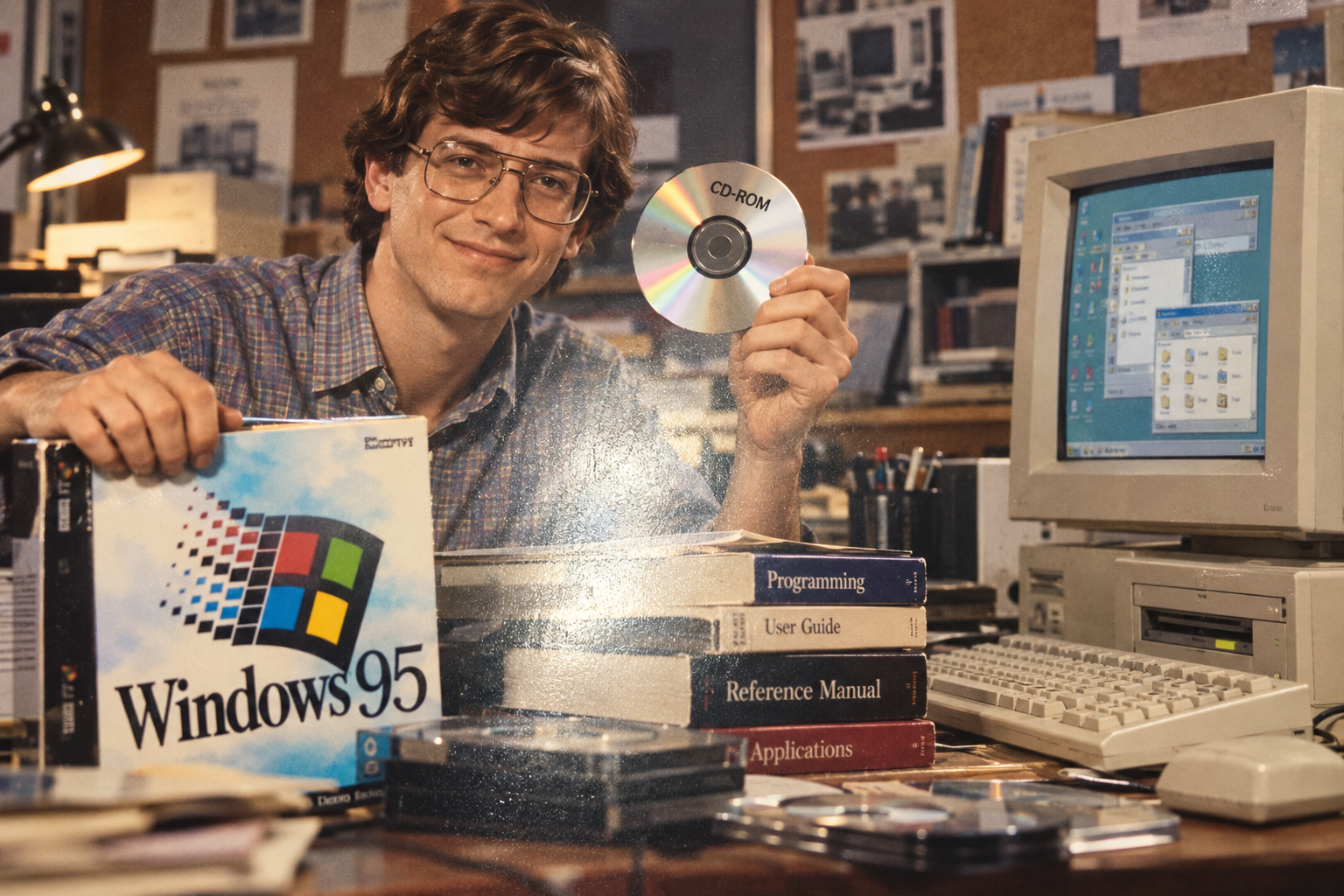
On August 24, 1995, Microsoft launched Windows 95 with one of the largest technology marketing campaigns of its time.
The company reportedly spent around $200 million promoting the new operating system. Its famous advertising question—”Where do you want to go today?”—appeared across television, magazines, billboards, and cinemas.
Windows 95 introduced features that became familiar to millions of computer users, including the Start menu, taskbar, and improved support for graphical computing.
For many people, this was their first real introduction to a computer that felt relatively easy to use.
Because Windows was widely distributed with IBM-compatible PCs, Microsoft’s operating system became enormously influential. By the mid-1990s, Windows dominated the personal-computer operating-system market.
Not everyone was happy about it, however. The popularity of Windows also produced plenty of criticism and humor. One contemporary description compared the system’s complexity to “a new car’s dashboard.”
A New Era of Computing
Windows 95 represented more than just another software release. It helped establish the personal computer as an everyday tool for millions of people.
Computers were no longer restricted to specialists and large organizations. They were increasingly found in homes, schools, offices, and businesses.
Microsoft’s journey from two young programmers working with the Altair 8800 to one of the world’s most influential technology companies reflected the rapid transformation of computing itself.
The story of Microsoft is ultimately a story about how software changed the relationship between people and machines.
What began with a small programming partnership in 1975 would eventually help shape the way an entire generation used computers.
The computer had become personal—and Microsoft was at the center of that transformation.