Gulf War
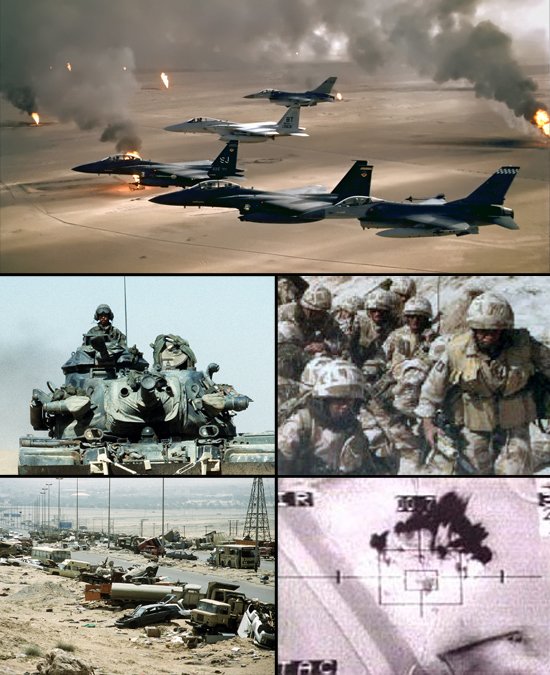
In August 1990, Iraq invaded Kuwait. Six months later, after the expiration of a United Nations deadline, a U.S.-led coalition drove Iraqi forces out of Kuwait.
By the 1980s, military historians were predicting that a future major conflict might begin not because of the Cold War, but as a result of tensions in the Middle East. In 1990, as the Cold War came to an end, Iraqi leader Saddam Hussein invaded and annexed Kuwait.
U.S. President George H. W. Bush, with the backing of the United Nations, began assembling an international coalition to drive Iraqi forces out of Kuwait and restore the country’s independence.
On the night of January 16, 1991, after economic sanctions had failed and Iraq had ignored a UN deadline to withdraw, coalition forces began bombing Iraqi military targets in both Iraq and Kuwait.
Iraq responded by launching missile attacks against Israel, hoping to draw Israel into the conflict and unite Arab nations against a common enemy. Israel ultimately agreed to a policy of nonretaliation, helping preserve the coalition’s unity.
DESERT STORM
After more than a month of aerial bombardment, Iraq began calling for a cease-fire, although Saddam Hussein refused to end his occupation of Kuwait.
On February 24, 1991, coalition forces led by U.S. General Norman Schwarzkopf launched a ground offensive known as Operation Desert Storm.
The ground campaign moved rapidly. Coalition forces advanced deep into Kuwait and captured large numbers of Iraqi soldiers. The Iraqi army offered relatively little resistance during the ground offensive.
Four days later, President George H. W. Bush announced the end of the war, declaring that Kuwait had been liberated and that the coalition’s military objectives had been achieved.
THE AFTERMATH
President George H. W. Bush was both praised and criticized for ending the war after the liberation of Kuwait rather than continuing to Baghdad and removing Saddam Hussein from power.
Supporters argued that the decision respected the limits of the United Nations mandate, while critics argued that Saddam Hussein remained in power despite having caused the crisis.
In the months that followed, Saddam’s government faced uprisings by Kurdish and Shiite communities in Iraq. Coalition forces provided safe havens and humanitarian assistance to refugees, while Saddam’s government eventually reasserted control over much of the country.
The Gulf War had lasting consequences for the Middle East. Although Iraqi forces were driven from Kuwait, Saddam Hussein remained in power, and tensions between Iraq and the United States continued throughout the 1990s and into the following decade.
THE INTERNATIONAL COALITION
The Gulf War brought together a large international coalition. Its forces included countries from different continents and diverse religious, political, and social backgrounds.
The coalition’s central objective was to reverse Iraq’s invasion of Kuwait and restore Kuwait’s sovereignty. The conflict demonstrated the ability of a broad international alliance, supported by the United Nations, to respond militarily to an invasion.