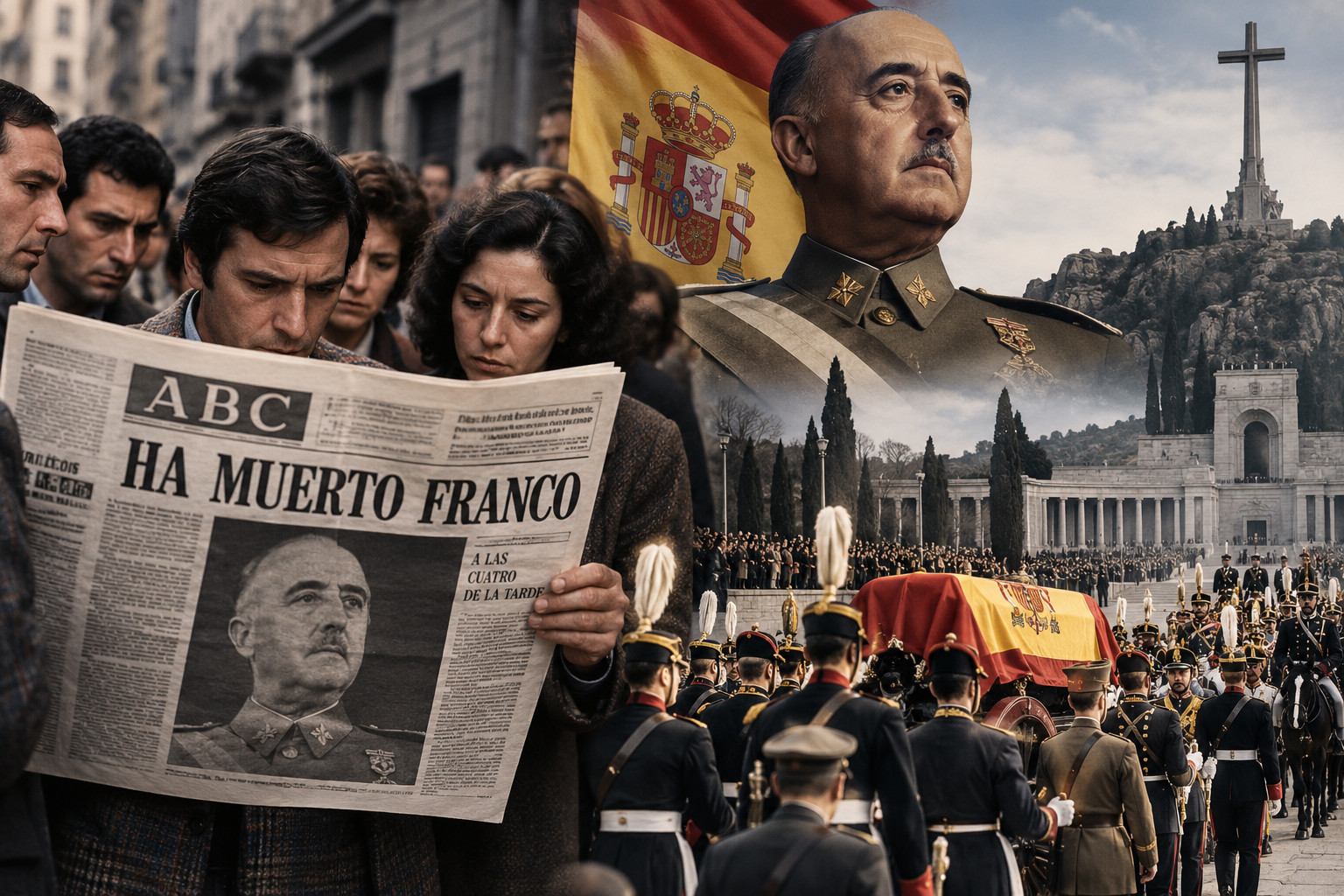
The Death of Franco: Spain’s Road to Democracy
The death of General Francisco Franco on November 20, 1975, marked a turning point in Spanish history. After nearly four decades of authoritarian rule, his death opened the way for Spain to transition towards a constitutional monarchy and a modern liberal democracy.
Franco’s Rise to Power
General Francisco Franco became the dictator of Spain in 1939, following the Nationalist victory in the Spanish Civil War (1936–1939). His victory was supported by his military leadership, assistance from Nazi Germany and Fascist Italy, and the limited military intervention of other European democracies on behalf of the Spanish Republic.
After taking control, Franco established an authoritarian regime that suppressed political opposition, restricted civil liberties and promoted traditional Catholic and nationalist values.
During the Second World War, Franco kept Spain officially neutral, although the regime supported the Axis powers in several ways. At a meeting with Adolf Hitler in 1940, Franco demanded significant territorial concessions in French North Africa as part of any agreement for Spain to enter the war. The negotiations failed, and Spain did not formally join the conflict.
Following the Second World War, Franco remained in power despite international criticism of his dictatorship. In 1947, Spain was declared a kingdom without a reigning monarch. In 1969, Franco officially designated Prince Juan Carlos, the grandson of Spain’s last reigning king, Alfonso XIII, as his successor.
Franco’s Plans for Spain’s Future
Franco intended the monarchy to continue his political system after his death. He expected Juan Carlos to preserve the principles of Francoism and maintain the institutions that had sustained the dictatorship.
Juan Carlos publicly accepted the succession under Franco’s legal framework and was required to swear allegiance to the principles of the National Movement. Franco also left a message urging Spaniards to remain vigilant against those he considered enemies of Spain and Christian civilization, including socialists, communists and liberals.
However, Juan Carlos ultimately chose a different path. Rather than simply continuing Franco’s authoritarian system, he supported political reform and the restoration of democratic institutions.
The Beginning of Democratic Reform
Francisco Franco died in Madrid on November 20, 1975, following a prolonged illness. Two days later, on November 22, Juan Carlos was proclaimed king of Spain.
Although Franco had expected his political legacy to survive, Juan Carlos began supporting a transition towards democracy. In July 1976, he appointed Adolfo Suárez as prime minister. Suárez had previously served within Franco’s political system but became a central figure in dismantling its authoritarian structures through legal reform.
The government introduced measures to legalize political parties, expand civil liberties and establish a representative parliamentary system. These reforms helped Spain move away from dictatorship without another civil war.
Spain Adopts a Democratic
In December 1976, Spanish voters overwhelmingly approved the Political Reform Law in a referendum, providing a legal foundation for the transition to democracy.
Spain held its first democratic general election since the Second Republic in June 1977. Political parties that had been banned or restricted under Franco were able to participate in the new political system.
The next major milestone came in December 1978, when Spanish voters approved a new democratic constitution. It established Spain as a parliamentary monarchy, recognized fundamental rights and freedoms, and created the constitutional framework for democratic government.
By 1978, Spain had made a decisive break with Franco’s authoritarian system, although the consolidation of democracy continued in the years that followed.
The Historical Significance of Franco’s Death
The death of Francisco Franco did not immediately create a democracy, but it removed the central figure around whom Spain’s dictatorship had been organized. The decisions of King Juan Carlos, Prime Minister Adolfo Suárez, political parties and Spanish citizens helped transform the country’s political institutions.
Spain’s transition became an important example of how a country could move from authoritarian rule to democratic government through negotiation, political reform and constitutional change.
November 20, 1975, therefore, remains a significant date in modern Spanish history. It marked the end of Franco’s personal rule and the beginning of a transformation that reshaped Spain’s political future.