Person: Neil Armstrong
Neil Armstrong
On 20 July 1969, millions of people around the w
orld watched a grainy television broadcast as a human being stepped onto the surface of the Moon.
That person was Neil Armstrong. His name became permanently connected with one of the greatest moments in human history. But Armstrong’s journey to the Moon was not simply the story of one astronaut. It was the result of years of scientific research, engineering, training, and competition during the Space Race.
Early Life
Neil Alden Armstrong was born on 5 August 1930 in Wapakoneta, Ohio, United States. He developed an interest in flying when he was young. At just six years old, he experienced his first airplane flight, and aviation quickly became an important part of his life. By the time he was a teenager, Armstrong had already earned a pilot’s license. He studied aeronautical engineering at Purdue University, but his education was interrupted when he was called into military service.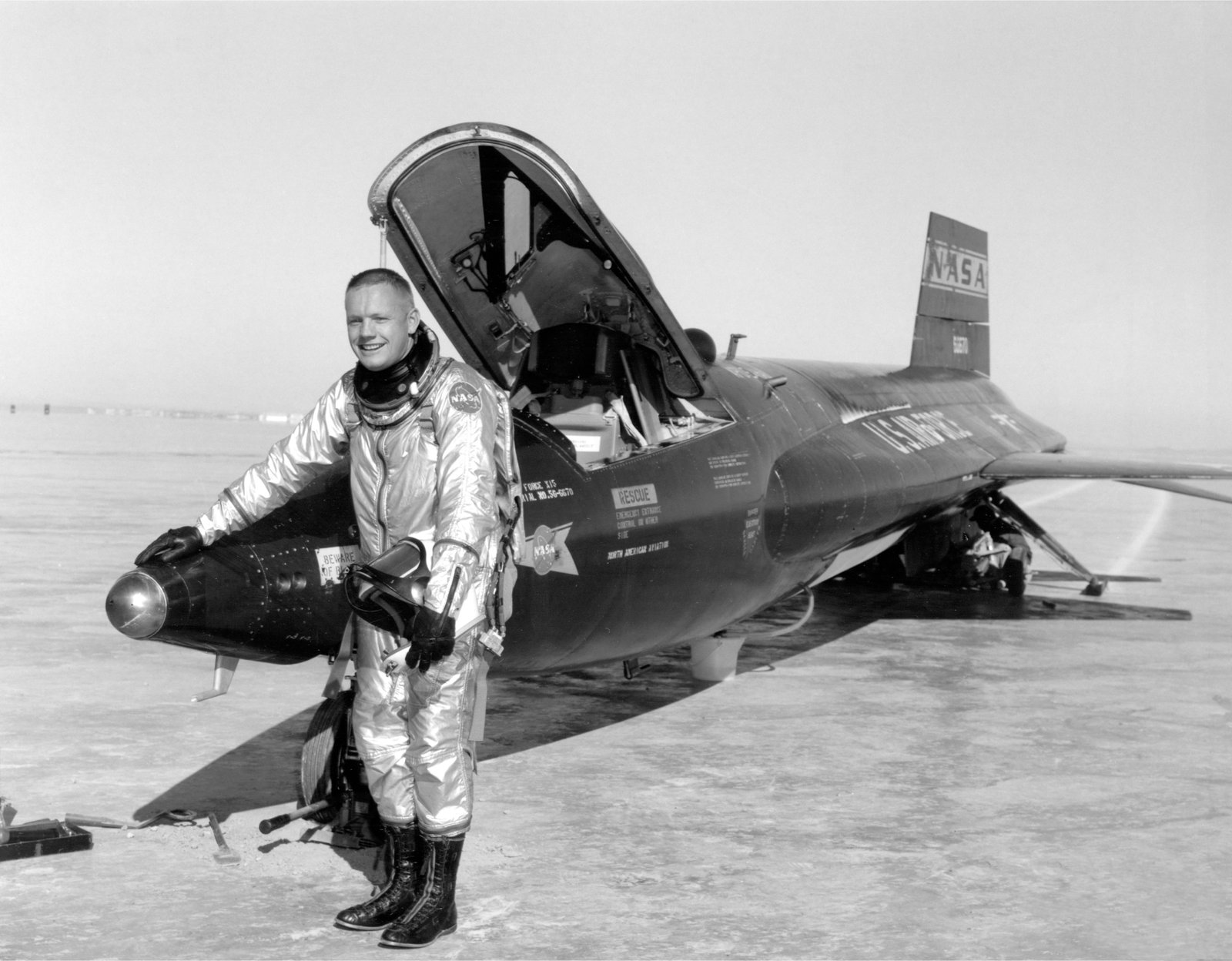
A Naval Pilot
Armstrong became a naval aviator and flew combat missions during the Korean War. He flew the F9F Panther, a jet fighter used by the United States Navy. During one mission, his aircraft was damaged and Armstrong had to eject. He survived the incident and returned to flying.His experience as a military pilot would later become valuable when he began working as a test pilot.
Test Pilot
After the Korean War, Armstrong joined the National Advisory Committee for Aeronautics, which later became part of NASA. He became a test pilot at what is now known as the Armstrong Flight Research Center in California. Armstrong flew many experimental aircraft, including the famous X-15 rocket plane. The X-15 could reach extremely high altitudes and speeds that were far beyond those of ordinary aircraft. Armstrong’s work as a test pilot required precision, patience, and the ability to remain calm when dealing with unfamiliar technology. These qualities would later become important during his space missions.
Joining NASA
In 1962, Armstrong was selected as part of NASA’s astronaut program. At the time, the United States and the Soviet Union were competing to demonstrate technological superiority in space.The Soviet Union had already achieved several major milestones, including launching Sputnik and sending Yuri Gagarin into orbit.The United States wanted to go further.President John F. Kennedy had set an ambitious goal: to land a human on the Moon and return them safely to Earth before the end of the 1960s.Armstrong became part of the team working toward that goal.
Gemini 8
Armstrong’s first trip into space came in March 1966, when he commanded Gemini 8 alongside astronaut David Scott.The mission achieved an important milestone: Armstrong and Scott successfully carried out the first docking of two spacecraft in orbit. But the mission soon became dangerous. After docking with an unmanned spacecraft, the combined vehicles began spinning uncontrollably. Armstrong and Scott were in serious danger. Armstrong managed to regain control of the spacecraft using the re-entry control system. The crew survived, although the mission had to be ended early. The experience demonstrated Armstrong’s ability to remain focused during an emergency.
Preparing for the Moon
NASA’s Apollo program continued through a series of increasingly ambitious missions. Each mission helped scientists and engineers learn more about lunar travel. Apollo 8 sent astronauts around the Moon. Apollo 10 tested the lunar landing procedures without actually landing.
Then came Apollo 11. Armstrong was selected as the mission commander. His fellow astronauts were Buzz Aldrin and Michael Collins.Collins would remain in lunar orbit aboard the command module while Armstrong and Aldrin descended to the Moon.
Apollo 11
Apollo 11 launched from Kennedy Space Center in Florida on 16 July 1969. The enormous Saturn V rocket lifted the spacecraft away from Earth and began its journey toward the Moon. After several days of travel, Apollo 11 entered lunar orbit. Armstrong and Aldrin then climbed into the lunar module, named Eagle. Collins remained aboard the command module, Columbia. The Eagle began its descent toward the lunar surface.
The Landing
The final moments of the landing were tense. The lunar module’s computer was producing warnings, while the original landing area contained obstacles that made it unsuitable. Armstrong took manual control of the spacecraft and searched for a safer place to land. The Eagle finally touched down on the Moon at 20:17 UTC on 20 July 1969. Armstrong reported:
“The Eagle has landed.”
Humanity had reached another world.
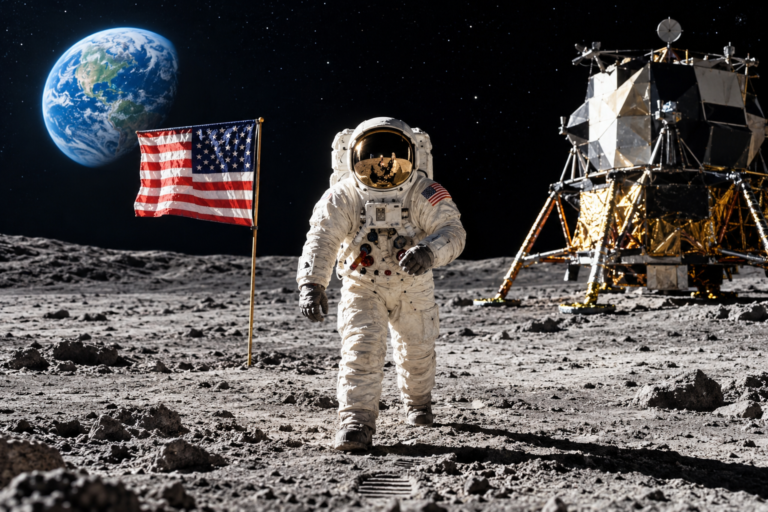
Several hours later, Armstrong opened the hatch and began climbing down the ladder. At 02:56 UTC on 21 July 1969, he stepped onto the lunar surface. He became the first human being to walk on another world. Armstrong spoke the famous words:
“That’s one small step for man, one giant leap for mankind.”
Soon afterward, Buzz Aldrin joined him on the surface. The two astronauts spent about two and a half hours outside the lunar module, collecting samples, taking photographs, and carrying out scientific experiments. Meanwhile, millions of people on Earth watched the historic event.
Returning Home
After completing their work on the Moon, Armstrong and Aldrin returned to the lunar module. They lifted off from the lunar surface and reunited with Michael Collins in lunar orbit. Apollo 11 then began its journey back to Earth. On 24 July 1969, the astronauts splashed down safely in the Pacific Ocean. The mission had succeeded. Humans had travelled to another world and returned home.
Life After Apollo 11
Armstrong became an international celebrity almost overnight. People around the world wanted to hear from the first person to walk on the Moon. But Armstrong was uncomfortable with fame. He generally avoided the celebrity lifestyle and preferred a quieter existence. He left NASA in 1971 and became a professor of aerospace engineering at the University of Cincinnati. He continued to participate in aviation and space-related activities, occasionally serving on important investigations and advisory boards.
The Challenger Disaster
In 1986, the Space Shuttle Challenger broke apart shortly after launch, killing all seven crew members. Armstrong later served as a member of the commission that investigated the disaster. The investigation examined the technical and organizational failures that contributed to the accident.Armstrong remained involved in discussions about the future of American space exploration for many years.
A Quiet Hero
Unlike many famous astronauts, Armstrong rarely sought the spotlight. He gave interviews and attended important events, but he often emphasized that the moon landing was the achievement of thousands of people. Engineers, scientists, technicians, astronauts, computer programmers, factory workers, and many others had contributed to Apollo 11. Armstrong understood that he had been the person who stepped onto the surface, but the journey had been a collective human effort.
His Final Years
Neil Armstrong continued to support aviation and space exploration throughout his later life. He remained interested in the future of human spaceflight and occasionally criticized decisions that he believed could weaken America’s space program. Armstrong died on 25 August 2012, following complications from heart surgery. He was 82 years old.
The Legacy of Neil Armstrong
Neil Armstrong’s greatest achievement was not simply becoming the first person to walk on the Moon. His story represents a moment when humanity crossed a boundary that had existed for thousands of years. For generations, the Moon had been something people could see but never touch. On 20 July 1969, that changed. Armstrong’s footprints remain on the lunar surface, preserved in the dust of a world where no human being had ever walked before. The Apollo 11 mission lasted only a few days, but its significance has lasted for generations. Neil Armstrong took one step onto the Moon, and humanity’s idea of what was possible changed forever.